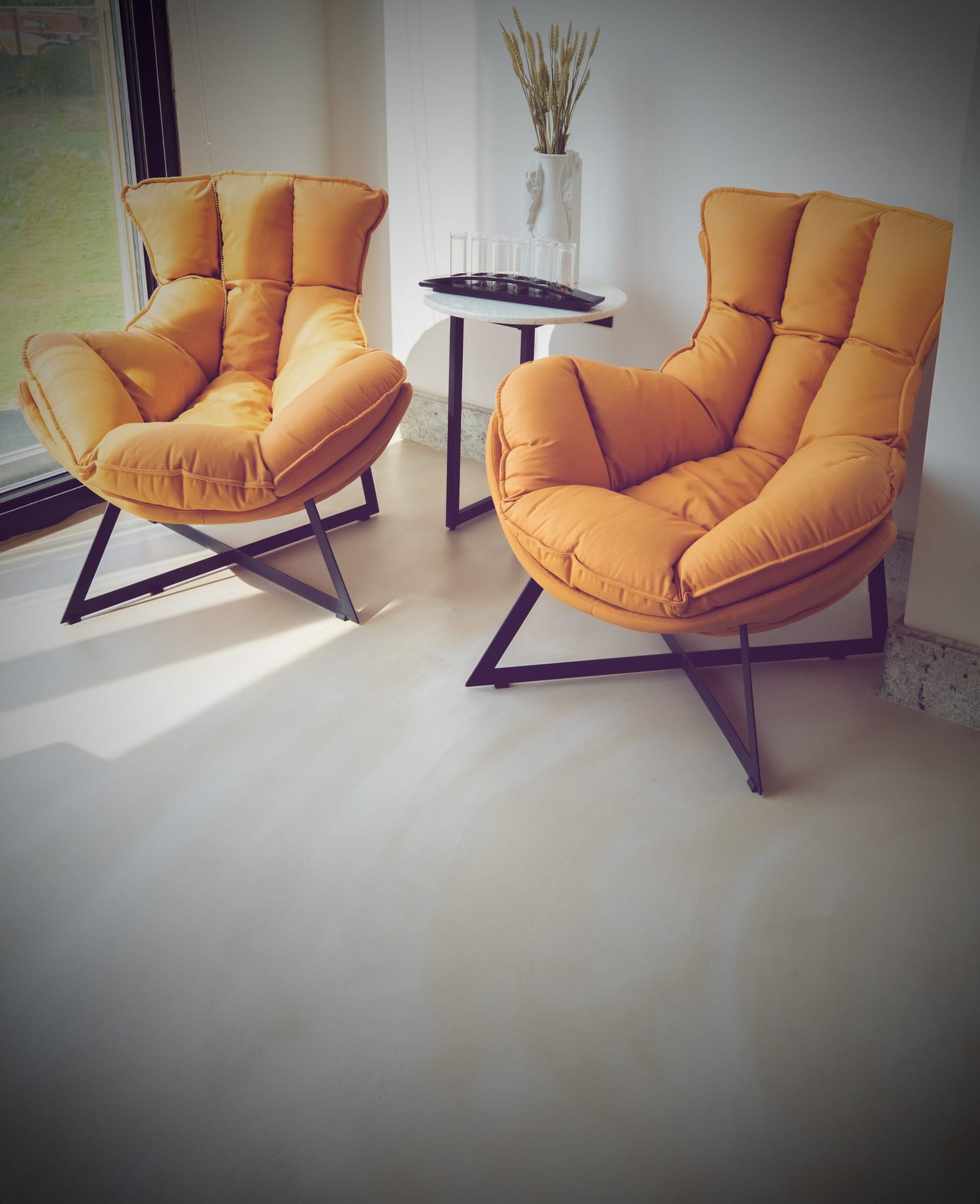
Microcement is a cement-based coating of fine cement, polymer resins and mineral pigment, hand-applied at roughly 2 to 3 millimetres over floors, walls and ceilings. It is seamless, hard-wearing and low-VOC, but it is a cementitious coating sealed with a protective finish, not a natural finish like clay or lime.
What is microcement made of?
Microcement is a coating made from fine cements, graded mineral aggregates, polymer resins and pigment. The Cemher Microdur Plus system we install is a three-component product: a white cement-based powder mixed on site with two liquid resins. The resin is what separates microcement from ordinary cement render, giving a very thin coat the adhesion and flexibility render cannot manage.
Colour is pigmented into the mix rather than painted on afterwards, so the tone runs through the coat. Texture comes from the grain size selected and from the trowel, which is why two rooms in the same colour can read quite differently. We cover this in microcement colours and textures.
The trowelled surface is then sealed, typically with a polyurethane sealer in matt, satin or gloss. The sealer is part of the system, not an optional extra: Cemher's data sheets state performance figures with and without it for exactly that reason.
How thick is microcement, and how does it go on?
Most builds finish at around 2 to 3 millimetres. The Microdur Plus data sheet allows 0.3 to 5.5 millimetres, but the working range on a real project is a few millimetres, applied in coats: base coats with an alkali-resistant fibreglass mesh embedded in the first, a sanding between coats, then finer finish coats and the sealer.
Application is skilled trowel work within a defined temperature window of 10 to 30 degrees, and sealing follows 24 to 48 hours after hardening once the coat is below five percent moisture. None of these steps is decorative flourish; each one appears in the manufacturer's data sheet as a condition of the stated performance.
That thinness is the material's quiet advantage. It goes over existing floors and old ceramic tiles without demolition or level changes, which is why so much microcement work is refurbishment. The full build-up is covered in how thick is microcement.
The Cemher systems: which microcement is which?
Microdur Plus is the general-purpose system: a three-component microcement, waterproof in mass in Cemher's wording, for continuous floors, walls and ceilings inside and out, with Class A1 reaction to fire — and expressly not for swimming pools or immersed surfaces.
Microrock is the high-traffic member of the range: a two-component polymeric microcement with a compressive class of C80, specified for garages, warehouses, galleries, stores and corridors, and not placed over underfloor heating.
Microtadelakt is honestly not a microcement at all: it is a one-component hydraulic lime plaster with marble dust in the same range, worked to tadelakt, marmarino or polished plaster effects at 1 to 4 millimetres.
Micropool is the immersion-rated system, the one product in the range that belongs inside a pool tank: where Microdur Plus is excluded from pools, Micropool carries the water-penetration and 28-day immersion results a pool detail needs. See microcement pools.
Where does microcement belong?
Floors are its home ground: villas, lobbies, retail and stairs, covered in microcement floors. Walls and ceilings carry the same material as one continuous plane, covered in microcement walls and ceilings.
It serves wet areas. Bathrooms and shower rooms are one of the strongest use cases, treated properly as a system with the right sealing, which we set out in microcement bathrooms. Kitchens work too, with one honest caveat about acids covered in microcement kitchens.
It also goes where an existing finish already is. Old ceramic tile is a listed substrate for Microdur Plus, which makes microcement over tiles a genuine refurbishment route rather than a workaround. Exterior terraces and facades are covered in microcement outdoors.
Where microcement does not belong
The wrong system in a pool. Microdur Plus is expressly unsuitable for swimming pools and continuously immersed surfaces; that work belongs to Micropool. A specifier who offers one microcement for everything is not reading the data sheets.
Worktops that will meet vinegar every day deserve a plain warning: the cementitious systems are sensitive to vinegar and other organic acids. The sealer is the defence, and spills should not be left to sit. This is a limit stated by the manufacturer, not a rumour.
It is also not a levelling compound, and it is not magic over a bad background. A weak, damp or moving substrate will report its problems through 2 or 3 millimetres of coating. We cover the honest failure modes in does microcement crack and the water question in is microcement waterproof.
Is microcement a natural finish?
No, and we say so plainly. Clay plaster and lime plaster are natural mineral finishes; microcement is a cementitious coating with polymer resins, closed with a sealer. It sits in our range because it does jobs the natural materials cannot: floors, hard traffic and direct-water zones.
What it does share with the natural finishes is a clean indoor-air story. The Cemher systems carry an A+ classification for emissions into indoor air, and Microdur Plus is Class A1 for reaction to fire. It is a low-VOC coating, not an off-gassing plastic film.
If the project wants a genuinely natural wall, the answer is clay plaster or lime. The comparisons worth reading are microcement vs limewash and polished plaster vs tadelakt vs microcement, and the whole family sits on materials.
Why do specifiers in Saudi Arabia choose it?
The first reason is the seamless plane. Contemporary work in Riyadh and Jeddah leans hard on continuous surfaces without grout lines or joints, and microcement delivers that across floor, wall, stair and ceiling in one material.
The second is that its durability is documented rather than asserted. Compressive class C50 for Microdur Plus and C80 for Microrock, surface hardness over 200 N/mm², abrasion class AR 0.5. Those numbers come from EN test standards on the data sheets, and they are why the material survives lobbies and stairs.
The third is versatility in wet areas, where the natural finishes bow out. At King Fahad Cultural Centre in Riyadh, microcement runs across the atrium floors, staircases and grand hall. At the Islamic Arts Biennale in Jeddah, Microdur Plus carries a restaurant interior. Both are public buildings taking real traffic.
Specifying microcement in Saudi Arabia
Conmarble supplies and installs the Cemher systems across Saudi Arabia, and the applicators are on our own payroll rather than subcontracted, which is what makes a consistent finish across a large floor achievable. The technical library for each system sits on microcement.
The useful first step is a sample panel in the real light of the real room, agreed before the finishes schedule is locked, and a substrate survey before anyone promises a programme.
Send drawings, substrate details and the finishes schedule through the enquire page, or message the Riyadh office on WhatsApp at +966 56 808 8273. Wellness, in Every Surface.