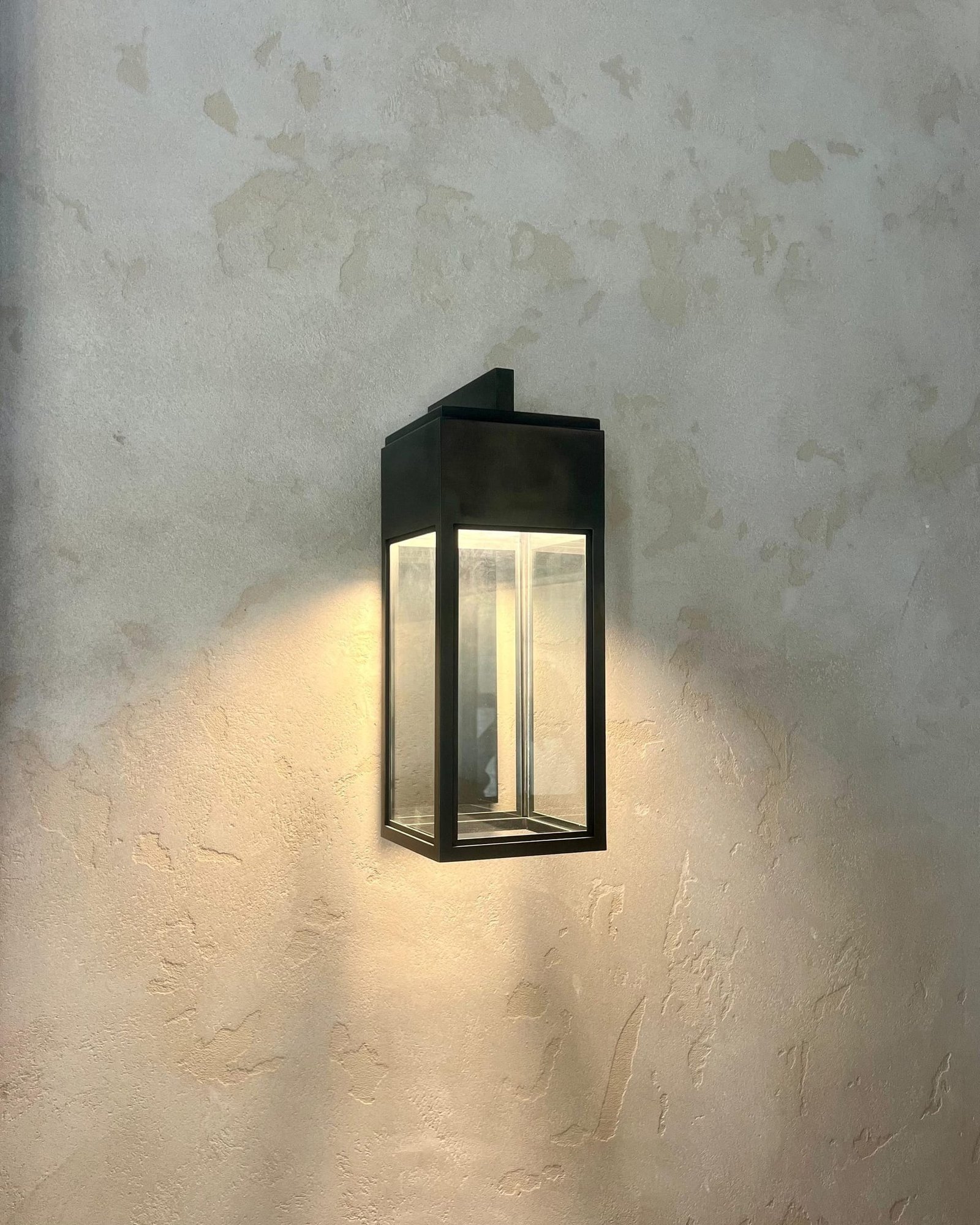
They do different jobs. Microcement is a cementitious coating, 0.3 to 5.5 mm, hard enough for floors, stairs and wet areas. Limewash is a breathable mineral paint for walls: soft, matt and shallow, with no wear layer. One is a working surface, the other a wall colour with depth.
Two mineral finishes that only look related
The confusion is understandable. Interiors publications show both materials as soft, cloudy, joint-free surfaces in near-identical palettes, and the words mineral and natural attach to each. On a screen, a limewashed wall and a microcement wall can pass for one another.
In the hand they are different objects. Microcement is a trowel-applied cementitious coating, built in coats over an embedded mesh and finished with a sealer — a surface with tested hardness, adhesion and water behaviour. The fundamentals are in what is microcement.
Limewash is a paint: lime and water with mineral pigment, brushed on in thin translucent coats that bond into a porous background. It has no mesh, no wear layer and no ambition to be walked on. Its character — and it has plenty — is covered in limewash wall finishes.
What microcement is, in one paragraph each
Cemher Microdur Plus is applied at 0.3 to 5.5 mm and tested like a floor product, because it is one: compressive strength Class C50, adhesion above 6 N/mm², abrasion Class AR 0.5, reaction to fire A1, and waterproof in mass in the manufacturer's wording. It goes on floors, stairs, walls, ceilings and worktops, indoors and out, and over old ceramic tile in renovation.
That performance costs it limewash's defining property. Microcement is a sealed system — Aquamax or Maxipur over the finish coats — so it is specified for washability and wear, not for breathability. It is chosen where the surface has to work: microcement floors and microcement walls show the range.
Where the wall behind it is damp or the room needs vapour-open surfaces, that sealed hardness is the wrong offer, and an honest specifier reaches for the lime family instead.
| Aspect | Microcement | Limewash |
|---|---|---|
| What it is | Trowelled cementitious coating with mesh and sealer | Brushed mineral paint of lime, water and pigment |
| Where it goes | Floors, stairs, walls, ceilings, wet areas, worktops | Interior walls and ceilings, mostly dry areas |
| Thickness | 0.3 – 5.5 mm applied system | Thin translucent coats; effectively paint-film depth |
| Water behaviour | Waterproof in mass, sealed; excluded from immersion | Breathable and open-pored; no wet-zone protection |
| Surface and ageing | Dense, stony, stable year after year | Soft, clouded matt that patinates over time |
| Upkeep and repair | Neutral cleaners; applicator repair and reseal | Dry dusting; renewed with another brushed coat |
| Where it wins | Working surfaces, wet rooms, renovation over tile | Breathable walls, atmosphere, easy renewal |
What limewash is, and why it is loved
Limewash colours a wall without filming over it. The wash sinks into a porous substrate and carbonates there, so the surface stays open-pored and the wall continues to exchange moisture vapour with the room — the breathability that mineral-paint people rightly prize.
Its appearance cannot be faked by rollers. The overlapping brush strokes dry to a clouded, chalky matt with gentle movement across the plane, and the finish ages by softening rather than by peeling. Renewal is simple: another coat, applied the same way, at paint cost rather than coating cost.
Its limits are equally plain. It is a wall and ceiling finish for mostly dry areas; it marks and rubs more readily than sealed coatings; and it offers no protection to a wet zone. It sits within a family of breathable mineral finishes alongside clay-based washes — see what is clay wash and the direct comparison in clay wash vs limewash.
Where each belongs
Give microcement the surfaces that take punishment: floors, stairs, bathrooms and wet rooms, kitchen walls, worktops, and any renovation going over existing tile. In wet areas the reasoning is set out in microcement bathrooms.
Give limewash the surfaces that are looked at rather than worked: bedroom and living-room walls, ceilings, corridors of houses rather than hotels, and any room where a breathable build-up matters more than a scrubbable one.
The overlap — a dry feature wall that either could finish — is decided by texture and temperament. Microcement gives a denser, stonier plane with trowel movement; limewash gives a softer, more atmospheric cloud with brush movement. Neither is the premium option over the other; they are different sentences in the same language. For the lime family's harder wet-area member, see lime plaster and tadelakt.
Upkeep, repair and ageing
Microcement is maintained like a sealed floor: neutral cleaners, no vinegar or organic acids — a listed sensitivity — and a sealer renewed on a cycle measured in years. Damage is repaired locally by an applicator and resealed; the material does not simply repaint.
Limewash is maintained like a loved wall: dry dusting, tolerance for the patina it develops, and a fresh coat when the room wants renewing. Scuffs that would mean repair on a coating are often just character on a limewashed plane, and when they are not, the fix is a brush, not a trade visit.
Ageing is where their temperaments show most clearly. Microcement is designed to look the same in year eight as in year one; limewash is designed to look better.
Using both in one scheme
The best answer to the versus question is usually and. A villa can run microcement through the floors, stairs, bathrooms and kitchen, then hand the bedroom and living walls to a breathable mineral paint, keeping one quiet palette across two systems that each work where they are strongest.
The junctions are simple because both finishes are matt and mineral: colours are matched across the systems at sample stage, and the change of material reads as a change of texture rather than a seam.
That mixed specification is common on our Gulf projects, and it is the arrangement we recommend more often than either material wall-to-wall.
Specifying mineral finishes in Saudi Arabia
Conmarble supplies and installs Cemher microcement alongside breathable clay and lime wall finishes across Saudi Arabia and the Gulf, with applicators on our own payroll, so the comparison above is a menu we install both sides of rather than a contest we referee.
The useful first step is sample panels of each candidate finish in the project's own light, agreed before the schedule is locked.
Send the room list and design intent through the enquire page, or message the Riyadh office on WhatsApp at +966 56 808 8273. Wellness, in Every Surface.