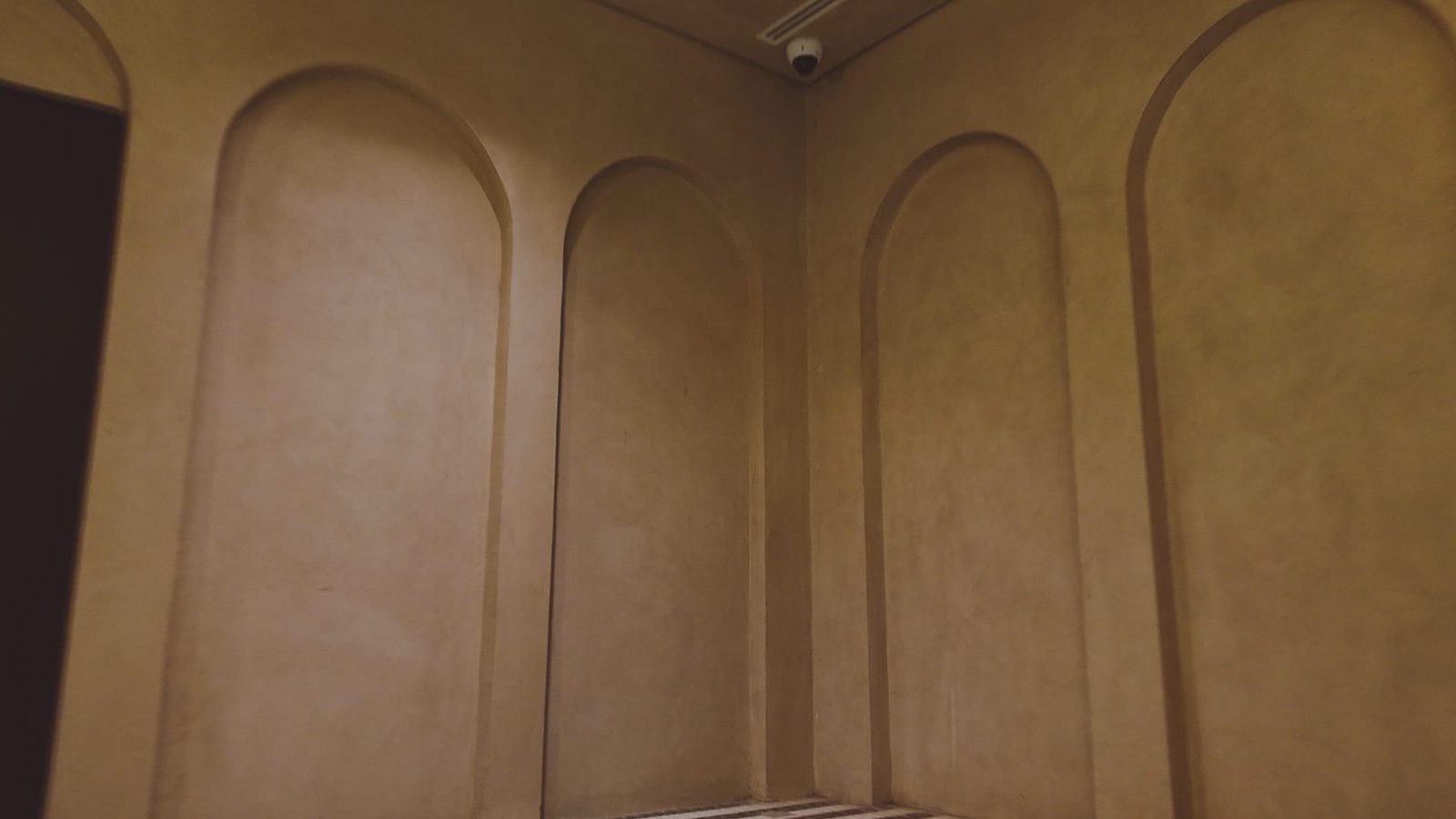
Limewash is a mineral paint made from slaked lime and water, usually with earth pigments. As it dries it absorbs carbon dioxide and turns back into calcium carbonate, bonding to mineral substrates. The finish is matt and chalky, with soft cloud-like tonal movement, and it suits porous interior and exterior masonry surfaces.
What is limewash?
Limewash is one of the oldest paints in existence: slaked lime — calcium hydroxide — dispersed in water, usually with a proportion of earth pigment for colour. It is brushed onto porous mineral surfaces in several thin coats, each one translucent on its own.
It is not a film-forming paint in the modern sense. Rather than sitting on the surface as a plastic layer, limewash soaks into a porous substrate and binds within it, so the finish becomes part of the wall rather than a coat over it.
That is also its first honest limit. Limewash needs a porous mineral background — lime plaster, masonry, render, stone. On a sealed or plastic-painted wall it has nothing to bind to, and no amount of technique changes that.
Carbonation: how limewash turns back into stone
Lime starts as limestone. Burning drives off carbon dioxide to make quicklime; slaking with water makes calcium hydroxide; and on the wall, the cycle closes. As limewash dries it absorbs carbon dioxide from the air and converts back into calcium carbonate — chemically, a thin layer of limestone.
This carbonation is the same chemistry that hardens our lime plasters, and it is slow. Limewash gains hardness over days and weeks rather than hours, and each thin coat needs to carbonate before the next goes on. Our note on lime plaster curing time covers why lime will not be hurried.
Fresh limewash is strongly alkaline, which is worth knowing twice over: wet lime demands careful handling on site, and that same alkalinity is what makes a cured lime surface inhospitable to mould — the chemistry behind it is set out in lime plaster and mould resistance.
Where the cloud-like movement comes from
The look people specify limewash for is the movement: soft clouds of tone drifting across a wall, denser where the brush loaded, lighter where it thinned. It is sometimes described as watercolour on architecture, and the description is fair.
The movement is not applied as a decorative effect. It is the honest record of how the material dries — lime carbonates at slightly different rates across the surface, and pigment settles unevenly as water leaves, so no two passes of the brush read identically.
The corollary is that limewash cannot be made uniform, and asking for a flat, even, repeatable colour is asking for a different material. A specifier who wants controlled consistency at paint weight is better served by clay wash; one who wants lime's character with more body and durability is better served by lime plaster.
How limewash behaves indoors
Indoors, limewash gives a matt, chalky, light-scattering surface that suits the same rooms as our other mineral finishes: living spaces, bedrooms, circulation, feature walls. It is vapour-permeable, has effectively nothing to off-gas once cured, and its alkalinity works quietly against mould.
It is a soft finish. Limewash chalks under abrasion, marks more readily than a modern emulsion, and is not scrubbable; it is refreshed by another thin coat rather than cleaned hard. In a corridor that takes trolley traffic, that is a real consideration rather than a footnote.
It also stays out of direct-water zones. A humid, ventilated room is within its range; a shower enclosure is not. Wet areas belong to tadelakt and Microtadelakt, which are burnished and soap-treated precisely so they can shed water — the distinction is covered in is tadelakt waterproof.
How limewash behaves outdoors
Limewash has centuries of exterior history — whitewashed villages around the Mediterranean are limewash at territorial scale. It suits porous masonry facades, reflects strong sunlight well, and lets a wall breathe rather than trapping moisture behind a film.
The exterior bargain is maintenance. Weather erodes limewash gradually, and traditional practice simply recoats on a cycle — an afternoon's brushing rather than a stripping job, because the new coat bonds to the old chemically. A specification that cannot accommodate recoating should not carry exterior limewash.
In the Gulf the sensible exterior questions are about exposure: driven dust, irrigation splash and hard-water staining at the base of walls do the most visible damage. Detailing copings and drips matters more to the life of the finish than the material itself.
Limewash, lime plaster and tadelakt: one chemistry, three weights
Limewash is the lightest member of a family. The same slaked lime, carbonating the same way, is worked at three weights: as a brushed wash, as a trowelled lime plaster with real body, and as tadelakt — lime compacted with a stone, burnished and soap-treated until it sheds water.
Our own lime work across Saudi Arabia sits at the heavier ends of that family. For bathrooms, hammams and spa suites we install tadelakt and Cemher Microtadelakt; for walls that want lime's depth with a consistent, specifiable build-up we install lime plasters — the full picture is in lime plaster and tadelakt in Saudi Arabia.
The photograph at the top of this page is exactly that: not limewash but polished Microtadelakt lime plaster, installed by our crews at the Calligraphy Museum in Madinah. The mineral softness that draws people to limewash survives the move up in weight; what changes is durability, and where the finish is allowed to go.
Limewash or something else?
Choose limewash for porous masonry, for heritage and vernacular contexts, and for schemes that want the cloudiest, most atmospheric version of a mineral wall and can live with a soft surface.
Choose clay wash where the brief wants a breathable mineral paint with a calmer, more controllable surface on modern substrates. Choose lime plaster or tadelakt where the surface must take touch, cleaning or water.
And where the comparison is with cement-based finishes rather than clay, the honest trade-offs — durability against breathability, uniformity against movement — are set out in microcement vs limewash.
Specifying lime finishes in Saudi Arabia
Conmarble supplies and installs the lime family across Saudi Arabia and the Gulf with applicators on our own payroll — lime plasters, tadelakt and Cemher Microtadelakt, alongside the clay and microcement finishes they usually share a schedule with. If a brief arrives saying limewash, we will tell you plainly whether limewash is what it needs, or whether the wall is really asking for lime at a different weight.
The starting point is a sample panel and a substrate conversation, because with lime the background decides most of the outcome.
Send drawings, substrate details and the finishes schedule through the enquire page, or message the Riyadh office on WhatsApp at +966 56 808 8273. Wellness, in Every Surface.