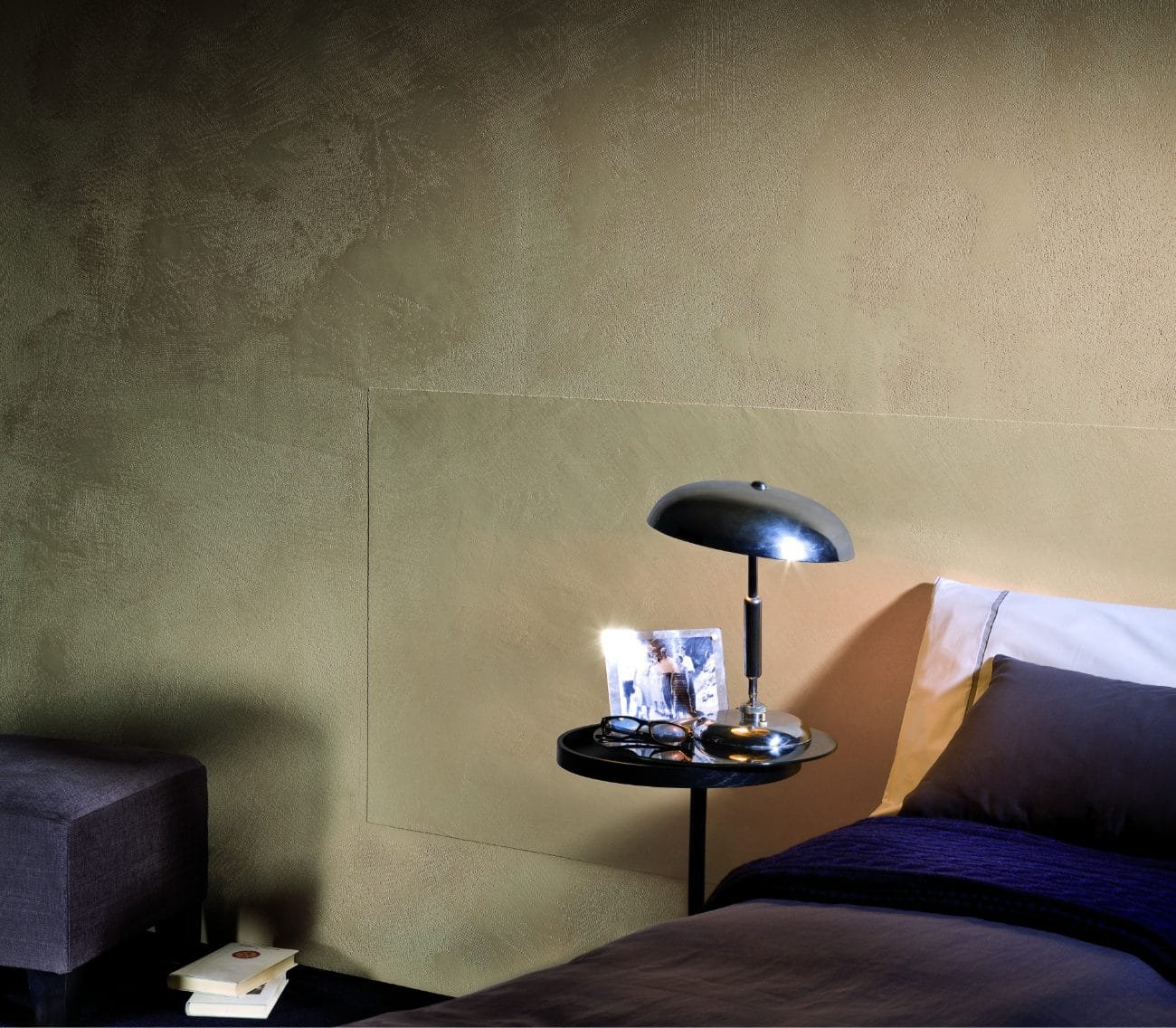
Clay wash is a natural paint made from fine clays and mineral pigment, brushed onto interior walls and ceilings in thin coats. It gives the soft, matt, tonal character of a clay surface at paint thickness rather than plaster thickness. It is breathable, very low in VOCs, and for interior use only.
What is clay wash?
Clay wash — often sold as clay paint — is a mineral wall finish made from fine clays and natural mineral pigment, applied by brush in thin coats. It sits between a conventional paint and a plaster: it goes on at paint weight, but the surface it leaves is mineral, matt and softly varied rather than a uniform film of acrylic colour.
The clay wash we supply and install is Cemher Claywash, a one-component clay paint made by Cemher in Spain. It arrives as a dry powder, is mixed on site and is brushed onto internal walls and ceilings in two coats.
The appeal is the character of the surface. Brushed clay dries with slight tonal movement and a completely matt face, so a wall reads as material rather than as coating. It is the quietest way to bring a clay surface into a scheme, and the lightest.
Clay wash vs clay plaster: the weight of the finish
The distinction matters more than the shared word. Clay plaster is a hand-applied finish with real body — from 2 mm in the Clayworks Smooth finish up to 6 to 8 mm in Rustic. That thickness is where its mass, its texture and its humidity buffering come from.
Cemher's data sheet is direct about the difference, and so are we: Claywash is a paint film, not a plaster. It does not provide the mass, the acoustic contribution or the humidity buffering that a clay plaster brings to a room. What clay does for indoor air at plaster thickness is covered in clay plaster and humidity.
The choice is therefore honest on both sides. Where the brief wants the look of clay across large areas, over ceilings, or on a repaint programme, the wash earns its place. Where the brief wants the performance of clay, specify the plaster and let the wash carry the secondary rooms.
Is clay wash the same as limewash?
No, though the two are constantly confused. Both are breathable mineral paints, but the binder differs: clay wash binds with clay and simply dries, while limewash is slaked lime that hardens by absorbing carbon dioxide from the air.
The surfaces differ accordingly. Clay wash dries to a soft, even, velvety matt with gentle movement. Limewash dries chalkier, with the cloud-like variation that comes from lime carbonating at different rates across the wall.
The full comparison — binder, alkalinity, substrates, maintenance — is set out in clay wash vs limewash.
The breathability and VOC story
Clay wash is specified as much for what it does not contain as for how it looks. Cemher's tested figure for Claywash is VOC emissions below 1 g/L, with an A+ indoor air quality classification — as low as paint classifications go.
The film itself is breathable, so it does not seal a mineral substrate behind plastic. The data sheet also lists it as highly flexible and crack resistant, and its reaction to fire is Class A1, the top non-combustibility class under UNE EN 13501-1:2019.
Breathable is the right word, and it is worth using precisely. The wash lets water vapour pass; it does not buffer humidity the way a clay plaster does, because there is very little clay mass in a paint film. Low-VOC mineral finishes of this kind can contribute to WELL, LEED and Mostadam assessments, though no paint is itself certified.
What does clay wash look like on a wall?
Completely matt, softly clouded, and alive to light. Because the material is brushed rather than rolled, the surface carries a faint record of the hand that applied it, and colour shifts gently across the wall rather than sitting flat.
In Gulf daylight that behaviour is the point. Strong, warm light raking across a matt mineral surface produces depth that a uniform emulsion cannot, and the same wall reads differently through the day.
Colour is agreed the same way as our plasters: against a physical sample panel in the real light of the real room, not against a screen. A tone that looks restrained on a swatch can behave very differently across a full wall facing a west window.
Where clay wash belongs — and where it does not
Interior walls and ceilings. That is the whole list. Claywash is for interior use only: it does not go on floors, it does not go outdoors, and it does not go in direct-water zones such as shower enclosures or the splash area around a basin.
Wet areas belong to lime. Tadelakt and Microtadelakt harden chemically and are made for water, which is why our bathroom and hammam work runs on them — see lime plaster and tadelakt in Saudi Arabia.
Within its zone the material is undemanding. The one application condition worth noting is a minimum temperature of +10 °C, which a conditioned interior in Saudi Arabia meets every day of the year.
How is clay wash applied?
In two coats, by hand, with a natural bristle block brush — the brush is specified because its marks are part of the finish. Coverage is economical: 3.5 litres of mixed paint covers 20 square metres in two coats.
The substrate does most of the work. Walls must be sound, dry, clean and prepared for a mineral coating; a sealed or glossy background defeats the material before the first coat goes on.
Preparation, coats, drying and repair are covered step by step in our clay wash application guide.
Specifying clay wash in Saudi Arabia
Conmarble supplies and installs Cemher Claywash with our own applicators, alongside the clay plasters, lime finishes and microcement it usually sits next to on a finishes schedule. The technical data sits on the Cemher Claywash specification page, and the wider palette on materials.
The useful first step is a brushed sample panel in the room the colour is destined for. It settles tone, texture and expectations in one visit.
Send drawings, substrate details and the finishes schedule through the enquire page, or message the Riyadh office on WhatsApp at +966 56 808 8273. Wellness, in Every Surface.