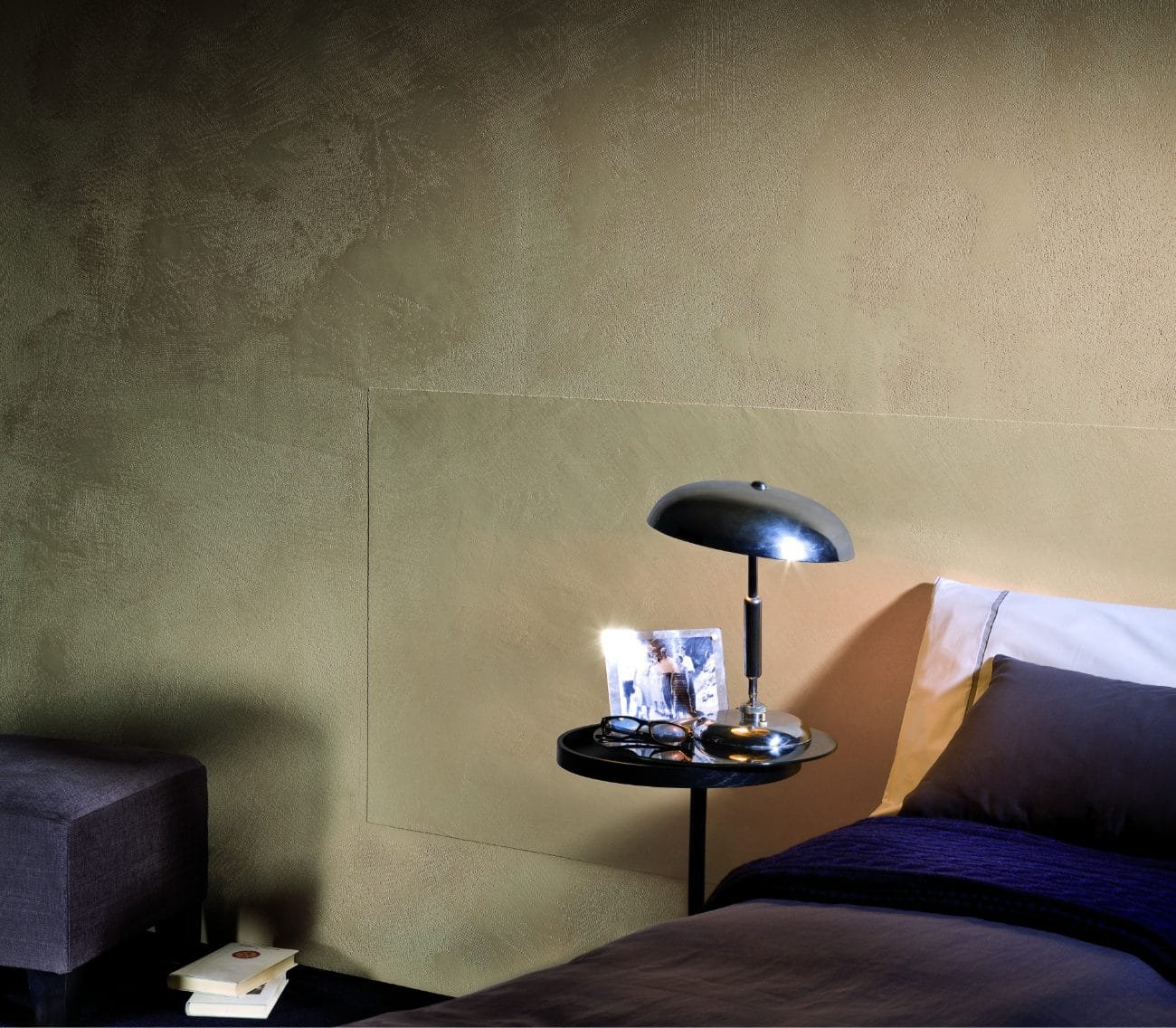
Clay wash and limewash are both breathable mineral paints, but the binder differs. Clay wash binds with fine clays and dries to a soft, velvety matt; limewash is slaked lime that carbonates into calcium carbonate, giving a chalky surface with cloudy movement. Clay suits modern interiors; limewash favours porous masonry.
Two mineral paints, one real difference
Set side by side, clay wash and limewash look like relatives. Both are matt, mineral, breathable and free of the plastic film a modern emulsion leaves. Both are applied thin, by brush, in more than one coat.
The difference is the binder, and it is total. Clay wash binds with fine clays and simply dries — the water leaves and the clay locks the pigment to the wall. Limewash binds with slaked lime, which does not merely dry: it absorbs carbon dioxide from the air and converts back into calcium carbonate, hardening chemically over days and weeks.
Everything that follows — surface character, alkalinity, substrate demands, maintenance, where each is allowed to go — falls out of that one distinction.
Surface character: velvet against cloud
Clay wash dries to a soft, even, velvety matt. There is tonal movement, but it is gentle and comes from the brush — a faint directional record of the stroke. Across a large wall the finish reads calm and controlled, which is why it sits comfortably in contemporary interiors.
Limewash dries chalkier and cloudier. Because lime carbonates at slightly different rates across the surface and pigment settles as water leaves, tone drifts in soft clouds that no two applications repeat. It is the more atmospheric surface and the less governable one.
Neither is superior; they answer different briefs. A scheme built on quiet, repeatable planes wants clay. A scheme that wants the wall itself to move — vernacular, heritage, deliberately hand-made — wants lime.
| Aspect | Clay wash | Limewash |
|---|---|---|
| Binder | Fine clays; dries as water evaporates | Slaked lime; carbonates into calcium carbonate |
| Surface character | Soft, velvety matt; gentle brush movement | Chalky matt; cloud-like tonal drift |
| Alkalinity | Essentially neutral, benign to handle | Strongly alkaline fresh; mould-resistant cured |
| Substrates | Prepared interior walls and ceilings, including modern boards | Porous mineral backgrounds: lime plaster, masonry, render, stone |
| Maintenance and recoat | Local touch-up; recoat without stripping | Chalks with wear; periodic recoat, bonds to old coats |
| Wet areas | No — dry interior zones only | No — humid ventilated rooms at most; direct water erodes it |
Alkalinity: neutral against caustic
Clay is essentially neutral. The mixed paint is benign to handle, kind to adjacent finished surfaces, and inert once dry.
Lime is not. Fresh limewash is strongly alkaline — caustic enough to demand eye protection and careful masking on site — and it stays reactive until carbonation is well advanced. That alkalinity is also limewash's gift: a cured lime surface is inhospitable to mould, the same chemistry described in lime plaster and mould resistance.
For a specifier the practical reading is simple. Lime brings a built-in biological resistance clay does not have, and it charges for it in site handling and programme, because carbonation cannot be hurried.
Substrates: tolerant against demanding
Clay wash is the more accommodating of the two. It asks for a sound, dry, prepared interior substrate with reasonable absorbency — plasterboard, gypsum, render and existing mineral finishes can all be brought to that condition, as covered in our application guide.
Limewash is choosier. It binds by soaking into a porous mineral background and carbonating within it, so it wants lime plaster, masonry, render or stone. On modern boards and previously painted walls it needs a mineral base built first, or it simply sits on the surface and chalks away.
This is usually the deciding factor on real projects. In a contemporary Saudi fit-out, where the walls are plasterboard and gypsum, clay wash meets the substrate as found; limewash asks the substrate to change.
Maintenance and recoat
Clay wash is touch-up friendly for life. Because it dries rather than cures, the same material feathers into a scuff locally, and a full recoat is one further brushed coat over a dusted surface.
Limewash weathers by chalking. Indoors that is slow and a refresh is rare; outdoors it is a genuine cycle, with recoating as routine maintenance rather than failure. The consolation is that recoating lime is easy — a thin coat bonds chemically to the old ones, and nothing is ever stripped.
Neither material is scrubbable, and neither pretends to be. A wall that must take hard cleaning belongs to a different family — burnished lime or microcement — not to a mineral paint.
Wet areas: the shared no
Here the two agree. Clay wash is for dry interior walls and ceilings only; direct water softens and marks it. Limewash tolerates humid, ventilated rooms somewhat better thanks to its alkalinity, but direct water erodes a soft porous lime paint too.
Showers, hammams and splash zones belong to lime at a different weight — tadelakt and Microtadelakt, compacted and soap-treated so the surface sheds water, described in lime plaster and tadelakt in Saudi Arabia.
If the comparison you are actually weighing is a mineral paint against a cementitious finish for a wet room, that is a different article: microcement vs limewash covers it.
So which should you specify?
Specify clay wash for contemporary interiors on modern substrates: consistent planes, very low VOC figures, easy local repair, and the soft mineral matt that reads as material rather than coating. It is the finish we hold as Cemher Claywash, applied in two brushed coats.
Specify limewash for porous masonry, heritage and vernacular contexts, and schemes that want the cloudy, atmospheric surface and can accept a soft finish with a recoat cycle.
And check the brief is not really asking for a third thing. Many limewash references on mood boards are, on inspection, plaster-weight surfaces — depth, texture, burnish — better served by clay plaster or lime plaster than by any paint.
Specifying natural paints in Saudi Arabia
Conmarble supplies and installs the whole shelf this comparison sits on — clay wash, clay plasters, lime plasters, tadelakt and microcement — with applicators on our own payroll, so the recommendation is not tied to a single product.
The quickest way to settle a clay-or-lime question is a pair of sample panels in the room's real light. We prepare both.
Send drawings, substrate details and the finishes schedule through the enquire page, or message the Riyadh office on WhatsApp at +966 56 808 8273. Wellness, in Every Surface.