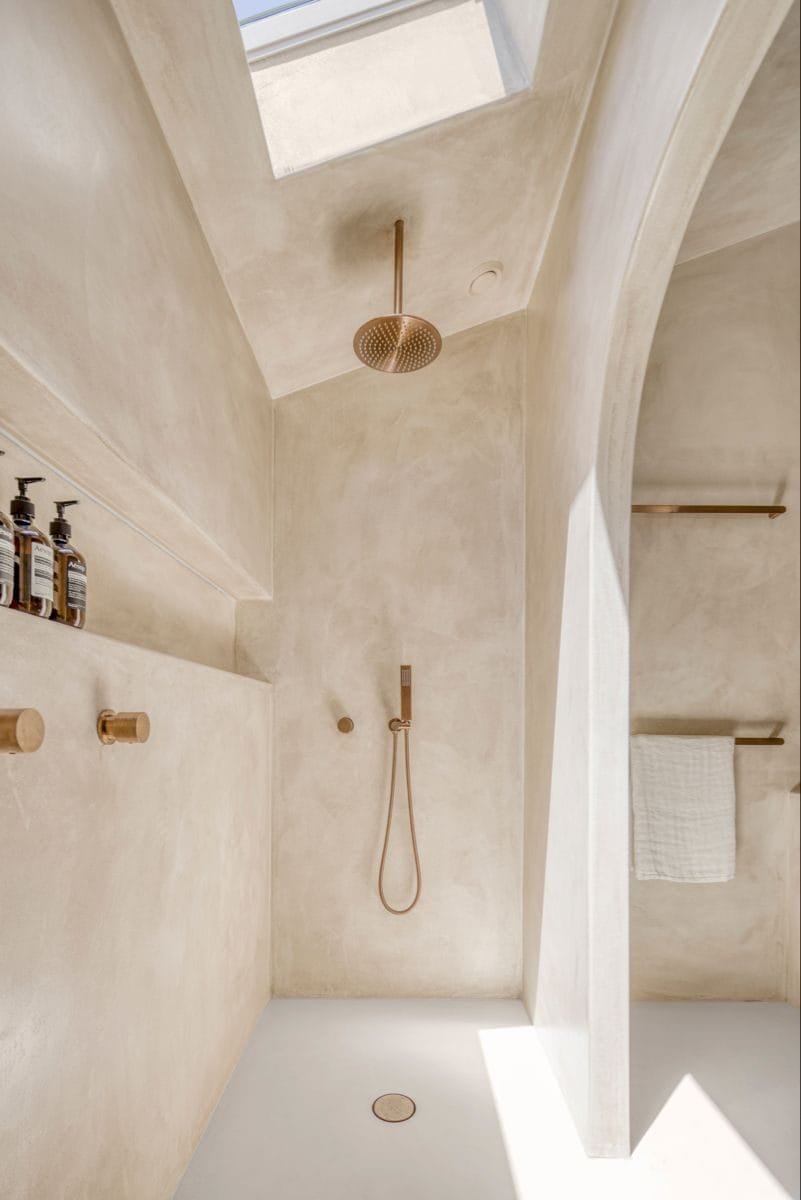
Yes. Cemher's Microdur Plus is waterproof in mass and its TDS lists bathrooms among its uses, walls and floors alike. A shower build-up needs a waterproofing membrane beneath, falls to the drain, mesh-reinforced base coats and a sealed finish. We installed it through the shower rooms at Katara Hills LXR, Doha.
Why bathrooms are where microcement makes its case
A bathroom is small, wet, hard-working and seen every day. Tiles answer it with a grid of grout lines; microcement answers it with one continuous mineral surface across floor, walls and ceiling, interrupted only by the drain and the door.
The appeal is not only visual. Grout is the maintenance liability of a tiled bathroom — it stains, harbours mould and eventually needs raking out. A seamless finish removes the joint as a category of problem, which is why the material keeps appearing on finishes schedules for villas and hotels across Riyadh and Jeddah.
It is also a renovation tool. Applied at millimetres of thickness, often over existing tiles, it can re-make a bathroom without demolition — a point covered in microcement over tiles and one that matters in occupied Saudi villas.
This is the deepest of our microcement guides because it consolidates the questions we are asked most. For the material basics first, see what microcement is.
Is it waterproof enough for a shower?
Yes, and the claim has a precise shape. Cemher describes Microdur Plus as waterproof in mass — the resistance runs through the body of the material, evidenced by a water-penetration test at 5 bar for 3 days with no penetration. Bathrooms are on the data sheet's list of uses, not an off-label experiment.
The finish is then sealed: Hidroprimer followed by Aquamax or Maxipur, 24 to 48 hours after hardening, once the surface is below 5% moisture. The mass keeps water out of the material; the sealer keeps soap, oils and cleaning chemistry off the face.
One boundary should be stated as plainly as the capability: this is a wet-area finish, not an immersion finish. Surfaces that stay permanently underwater belong to Micropool, as explained in is microcement waterproof and microcement for pools.
The membrane: where the real waterproofing sits
A correct wet room is a system, and the building's waterproofing is not the finish — it is the membrane beneath it. Tanking to the wet zones, falls formed in the screed, sealed junctions at corners, drains and penetrations: all of that is complete before the first coat of microcement is mixed.
The layers then read, from the substrate up: membrane and preparation, two base coats with fibreglass mesh embedded in the first, finish coats, sealer. Total applied thickness runs 0.3 to 5.5 mm — thin enough that thresholds, door swings and drain levels rarely need rework, as covered in microcement thickness.
The redundancy is deliberate. If the finish is ever damaged, the membrane still protects the structure; because the finish is waterproof in mass, damage does not soak the coating in the meantime. Each layer fails safe for the other, which is exactly what a hotel operator or a homeowner should want behind a shower wall.
Walls and ceilings: the seamless envelope
Walls are the least contentious surface in the room. Microdur Plus is listed for interior walls and ceilings, goes over plastered blockwork, cement render, concrete and sound existing tile, and carries corners, curves and niches without a joint — the qualities explored in microcement walls.
Ceilings matter more in bathrooms than anywhere else, because steam reaches them daily. Carrying the same sealed finish overhead closes the room as one envelope and avoids the painted-ceiling-peeling-above-the-shower problem familiar from conventional bathrooms.
Colour behaves differently in a small wet room than on a sample card. Pale tones hide water marks better than near-blacks, and Gulf daylight through a lightwell will shift a grey noticeably warmer. We keep the palette conversation practical in microcement colours, and sample panels settle it.
Floors and shower floors: falls, drains, slip
Bathroom floors are listed uses too, and the practical questions are geometric. The finish follows its substrate, so falls to the drain are formed in the screed beneath, not built up in microcement. A linear drain at the wall keeps the floor as one uninterrupted plane, which is where the material looks its best.
Slip is a data-sheet answer rather than a guess: the tested finish records USRV 41, Class 2 slip resistance. Texture can also be adjusted through grain and sealer sheen — a shower floor is finished less polished than a bedroom floor, deliberately.
Underfloor heating is compatible — Microdur Plus is approved over both hot-water and electric systems — and bathroom floors connect naturally to the wider subject of microcement floors, including how they behave under years of traffic.
Inside the shower: details that decide the outcome
The shower enclosure is the hardest-working two square metres in the house, and the details are what separate a ten-year surface from a call-back. Junctions between wall and floor are reinforced and made continuous; the mesh in the base coat carries across changes of plane rather than stopping at them.
Penetrations are the other discipline. Mixer valves, niches, glass fixings and the drain edge are sealed as details, not left to the general build-up. Water is patient; it finds the one interruption in an otherwise continuous surface.
Programme honesty belongs here too. Coats go on at their stated intervals, the sealer waits its 24 to 48 hours and its moisture reading, and the sealer itself needs its full cure before the first shower runs. A microcement bathroom is quick against tiling, but it is not an overnight job, and anyone promising otherwise is cutting one of these steps.
Cracking in wet rooms is nearly always a substrate or membrane story rather than a material one — the mechanisms are set out in does microcement crack.
Living with it in the Gulf: hard water and cleaning
Water across the Gulf is hard, and hard water leaves pale mineral marks on any smooth dark surface as it dries — glass, stone and microcement alike. The practical habits are simple: a squeegee or cloth over the wettest zones after use, and pale-to-mid tones where daily wiping is unrealistic.
Cleaning is pH-neutral, full stop. The data sheet states the finish is sensitive to vinegar and other organic acids, which rules out exactly the descaling products hard water tempts people towards. Limescale removers, vinegar and acidic bathroom sprays will etch the sealer; soap and neutral cleaner will not.
The sealed surface otherwise resists the bathroom's ordinary chemistry — the tested resistance list includes water, oils and ammonia — and the long-term rhythm is periodic inspection of the sealer in the hardest-worked zones, with re-sealing when wear shows rather than on an invented schedule.
Katara Hills LXR, and specifying your own
At Katara Hills LXR in Doha we installed Microdur Plus through the shower rooms and the flotation room — wet areas in daily five-star use, repeated across many identical keys, where consistency of finish is the whole job. Hotel housekeeping regimes are also the sternest cleaning test a sealed finish faces, and the specification above is the one that passes it.
Where the design wants a warmer, more hand-made wet room, the honest alternative is lime: tadelakt delivers the hammam surface, compared directly in is tadelakt waterproof. And where the choice is against tiles or epoxy, microcement vs epoxy vs tiles sets out the trade plainly.
Conmarble supplies and installs the Cemher systems across Saudi Arabia with applicators on our own payroll. Send bathroom drawings, wet-area extents and substrate details through the enquire page, or message the Riyadh office on WhatsApp at +966 56 808 8273. Wellness, in Every Surface.