All three work in Gulf wet areas when detailed correctly. Tiles are the proven, repairable default with the widest supply chain. Epoxy wins on chemical resistance in service areas. Microcement gives a joint-free mineral surface at 0.3 to 5.5 mm, and goes over existing tile in renovation. Zone and detailing decide.
Three systems, and the question that sorts them
Tiles are fired ceramic units in an adhesive bed, jointed with grout. Epoxy is a resin coating, poured or rolled, that cures into a continuous plastic film. Microcement is a cementitious coating trowelled in thin coats over a meshed base and finished with a sealer — a mineral surface rather than a resin one. An overview of the material sits at what is microcement.
The sorting question is not which is best but what the room does. A hotel guest bathroom, a commercial kitchen and a spa corridor are all called wet areas, and they are three different duties: direct and constant water, chemical and thermal abuse, and humidity with heavy cleaning.
Most wet-area failures in the region are not material failures at all. They are detailing failures — wrong falls, interrupted waterproofing at corners and niches, no movement accommodation, rushed curing before handover. Any of the three systems fails over bad detailing, and all three last over good detailing. The finish is chosen after that logic, not instead of it.
Where tiles win
Tiles are the incumbent for good reasons. The fired surface is essentially inert: it does not care about heat, UV or most chemicals, and a glazed tile itself is as waterproof as building materials get. Supply is everywhere in the Gulf, every contractor can lay them, and slip behaviour can be specified off the shelf, because manufacturers publish rated ranges for barefoot and wet duty.
Repair is their quiet superpower. A cracked or damaged tile is cut out and replaced from attic stock, and the repair is invisible and permanent. No coating system — resin or cementitious — matches that predictability.
The weakness is the joints. Grout is the porous, staining, discolouring component in an otherwise inert surface, and in hard Gulf water it collects scale and detergent residue faster than anywhere else in the room. Hidden failures behind tiles — tanking that has let go without visible evidence — are the expensive version of the same problem: the joints let water tell a lie for years.
| Aspect | Microcement | Epoxy resin | Ceramic tiles |
|---|---|---|---|
| Appearance and joints | Continuous mineral surface, no joints, trowelled depth | Continuous but reads as a plastic coating | Modular with grout joints; widest choice of looks |
| Thickness and weight | 0.3 – 5.5 mm; renovates over existing tile | Thin film to a few mm; needs a sound bare substrate | Tile plus adhesive bed; the heaviest and thickest build |
| Slip and grip | USRV 41, Class 2; tuned by grain and matt sealer | Smooth to heavily aggregated, as specified | Off-the-shelf slip-rated ranges for every duty |
| Repair | Local applicator repair, then reseal | Recoat; sheen differences tend to show | Replace single tiles invisibly from attic stock |
| Hygiene and cleaning | No grout; neutral cleaners; avoid vinegar and organic acids | Non-absorbent; tolerates the harshest chemicals | Inert surface but grout stains and scales in hard water |
| Where it wins | Guest-facing wet rooms, seamless design, renovation | Commercial kitchens and service wet areas | Standard bathrooms, immersion, predictable maintenance |
Where epoxy wins
Epoxy is a performance coating, and in its own territory it is the correct answer. Commercial kitchens, laundries, plant rooms and back-of-house wash-down zones need chemical resistance against strong detergents and degreasers, and a well-specified resin system with coved skirtings is built for exactly that duty.
It is seamless, fully non-absorbent and can be laid with graded aggregate for reliable slip resistance under greasy water — a service-floor problem tiles handle less gracefully.
Its limits are aesthetic and environmental. Epoxy reads as a coating rather than a material: a uniform plastic film with no mineral depth, which is why it rarely survives contact with a design-led interior. Many epoxies also amber under UV unless a stabilised topcoat is specified, and repairs or recoats tend to show as sheen differences. In a guest-facing bathroom it is usually the wrong tool; in the kitchen behind it, often the right one.
Where microcement wins
Microcement's case is the continuous mineral surface. Floor, wall, hob and bench can carry one material with no joints, which removes grout from the cleaning conversation entirely and gives the seamless reading that tiles cannot produce. The system is thin — 0.3 to 5.5 mm applied for Microdur Plus — and light, so it renovates over existing tiles without demolition, covered in microcement over tiles.
The performance behind the appearance is tested rather than asserted: waterproof in mass in Cemher's wording, no water penetration under 5 bar over three days, adhesion above 6 N/mm², and an A1 reaction-to-fire class that resin systems do not reach. What waterproof in mass does and does not mean is set out in is microcement waterproof.
Its honest limits: it is a sealed system, so long-term behaviour rides on the sealer being maintained; it is sensitive to vinegar and other organic acids, which is a real consideration near kitchens; and immersion is excluded for Microdur Plus — pool tanks take Micropool, as explained in microcement pools. Repairs are possible and local, but they are applicator work, not a spare tile from a box.
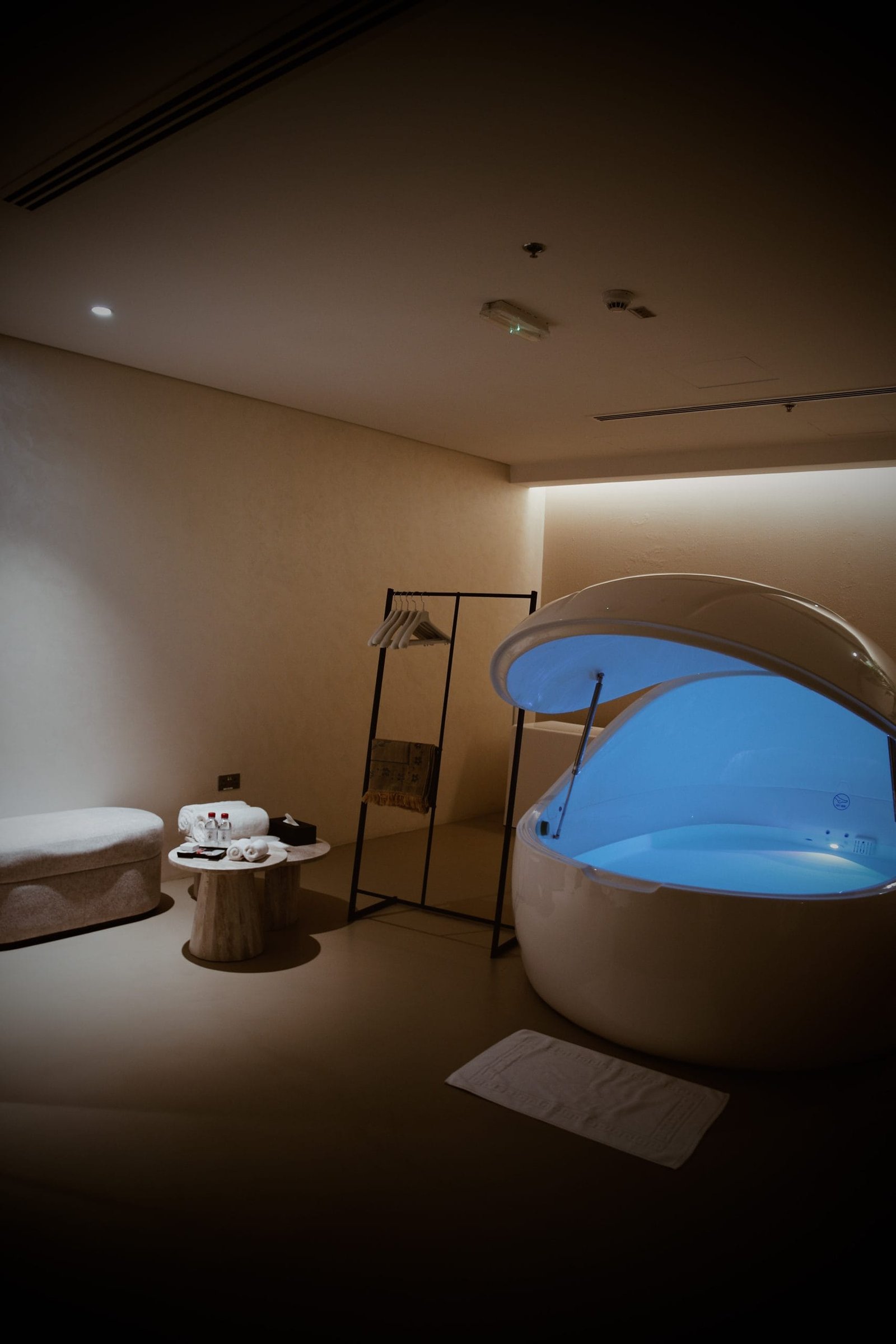
At Katara Hills LXR in Doha the shower rooms and the flotation room carry Microdur Plus as one continuous surface, which is the use case where the material is not merely competitive but unmatched: microcement bathrooms covers that room type in full.
Slip, cleaning and repair: the rows that decide
On slip, tiles offer the widest certainty because rated products exist for every duty. Microcement's tested value is USRV 41, Class 2, adjusted in practice through finish grain and matt sealers; epoxy spans everything from glass-smooth to heavily aggregated. For a wet barefoot zone, judge a wetted sample of whichever system you choose, not a datasheet line.
On cleaning, the two seamless systems win the daily routine — no grout to scrub or re-whiten under hard-water scale — while epoxy tolerates the harshest chemicals. Microcement wants neutral cleaners and an intact sealer; tiles forgive careless cleaning best of all, everywhere except their joints.
On repair, the ranking reverses: tiles first by replacement, epoxy by recoating with visible sheen shifts, microcement by local applicator repair and reseal. Specifiers weighing appearance against these practicalities can see the same trade-offs among mineral finishes in polished plaster vs tadelakt vs microcement.
Choosing in practice
Ask what governs the room. If it is chemical and thermal abuse in a service space, specify epoxy and do not look back. If it is predictable maintenance with local trades, or a wet zone that must carry a rated slip figure off the shelf, tiles remain the rational default.
If the room is guest-facing and the design intent is a continuous material surface — bathroom, spa, wet room, or a renovation where demolition is unaffordable — microcement is the system built for exactly that brief, provided it is installed as a full system by an applicator who owns the detailing.
Larger projects rarely choose once. A Gulf hotel will sensibly run epoxy in the kitchens, tiles in back-of-house ablutions, and microcement through the guest bathrooms and spa, and every one of those is the right answer in its own room.
Specifying wet-area finishes in Saudi Arabia
Conmarble supplies and installs Cemher microcement across Saudi Arabia and the Gulf with wet-area applicators on our own payroll, and we will say plainly when a room is a tile room or an epoxy room rather than force our material into it.
Send the room schedule, the zones and the cleaning regime through the enquire page, or message the Riyadh office on WhatsApp at +966 56 808 8273, and we will come back with a straight recommendation per room.
Wellness, in Every Surface.