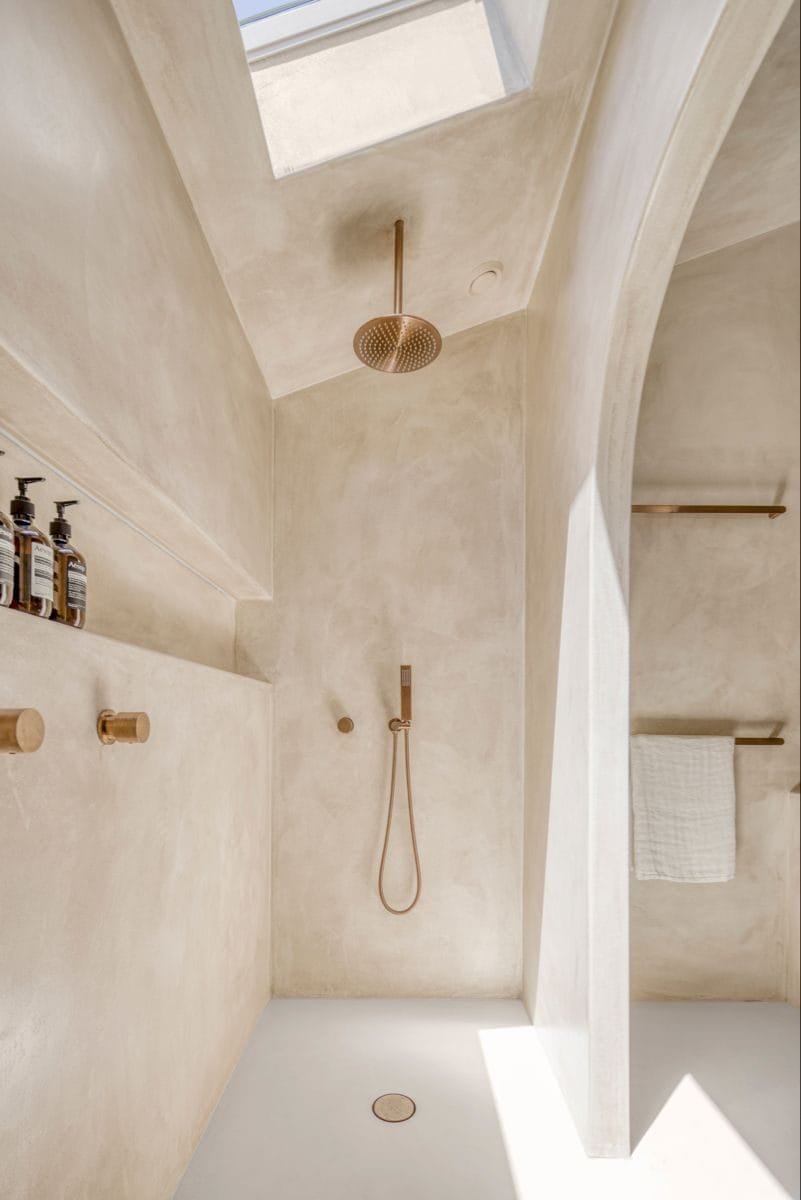
Yes. Old ceramic tile is a listed substrate for Cemher Microdur Plus, applied directly with no bonding bridge, at 0.3 to 5.5 mm total. The tiles must be sound, clean, grease-free and firmly bonded; hollow, loose or leaking tiled surfaces come off first. The survey decides, not the wall's appearance.
What the data sheet actually says
This is not an installer's improvisation; it is on the manufacturer's paper. The Cemher Microdur Plus technical data sheet lists coating of old ceramic tile among the product's intended uses, and old ceramic tile among its substrates. The substrate note is blunt: no bonding bridge — apply directly.
The same sheet carries the caveats. The tiled surface must be clean, free of grease and consolidated, and where the substrate needs help, the system prescribes it: a mortar consolidator for weak backgrounds, and vapour or rising-damp barriers where moisture is coming up from below. Adhesion is tested at over 6 N/mm² to UNI EN 13892-8, which is the figure that makes direct application defensible.
One distinction inside the range matters. Microrock, the high-traffic microcement, takes ceramic substrates only after mechanical roughening, and any old varnish or paint must be fully removed first. The lime-based Microtadelakt also lists old ceramic tile coverings. Which product, and therefore which preparation, is a specification decision, not a site habit.
Why renovation is where microcement earns its keep
Stripping a tiled bathroom is loud, slow and dirty. The tiles come off with a breaker, the adhesive bed comes off behind them, the waste goes down the corridor in bags, and the plumbing behind the wall is one careless blow away from a second project. In an occupied hotel or a family villa, that disruption is often the real cost.
Microcement removes most of it. The finished system is 0.3 to 5.5 mm thick, so it goes over the existing tile without rebuilding floor levels, trimming doors or introducing thresholds between rooms. How that build-up works layer by layer is covered in how thick microcement is.
Weight follows the same logic. A coating measured in millimetres adds a small fraction of what a new tile-on-tile layer with its adhesive bed would add, which matters on suspended slabs and in towers where the structural engineer has an opinion about every renovation. For an introduction to the material itself, start with what microcement is.
How the system goes on over tile
First the survey. Every tile is checked for hollowness, the surface is cleaned and degreased, and any soap film, sealer or gloss residue is taken off, because the data sheet's clean and grease-free condition is doing real work in that sentence.
Then the build-up. The first base coat goes on with an alkali-resistant fibreglass mesh embedded while it is fresh, which bridges the grout joints and distributes movement so the joint pattern does not telegraph through the finish. A second base coat follows, is sanded, and the finish coats go over it.
Sealing completes the system: Hidroprimer and then Aquamax or Maxipur, 24 to 48 hours after hardening and only once the surface is below 5% moisture. Application sits between 10 and 30 °C throughout. Cracking in microcement is nearly always a preparation story rather than a material one, and we cover it honestly in does microcement crack.
When the tiles must come off instead
A coating is only as good as what it is bonded to, so the cases for demolition are the cases where the tile bed itself is failing. Tiles that sound hollow under a tap test, tiles that rock, or areas where the adhesive has let go are removed and made good — covering a loose tile just transfers its movement into the new surface.
Active leaks are the second disqualifier. If water is getting behind a tiled shower wall or under a tiled floor, the microcement would seal the evidence in rather than the water out. The leak is found and fixed first, which usually means opening up, and at that point the room is being retiled or recoated from a sound base anyway.
The third is structural movement. Cracks that run through tiles and substrate together are the building moving, not the finish failing, and no 3 mm coating arbitrates that. Movement joints in the background stay as movement joints; they are respected in the new surface, not skimmed over.
None of this can be judged from photographs. A tiled room that looks tired can be a perfect substrate, and one that looks fine can be drummy across half the floor. The survey decides.
What about bathrooms and wet rooms over tile?
Bathrooms are where the question is usually asked, because they are where the tiles usually are. Microdur Plus is described by Cemher as waterproof in mass, and the tested figures behind that are unusual for a decorative coating: no water penetration under 5 bar of direct pressure over three days.
Waterproof in mass is the manufacturer's wording and we keep to it, because it is not the same claim as unconditionally waterproof. Falls to drains, junction detailing and the condition of whatever tanking sits beneath the old tiles still decide how a wet room behaves. The full picture is in is microcement waterproof and microcement bathrooms.
The one place a tiled surface should not be overcoated with Microdur Plus is a pool or any continuously immersed surface — the data sheet excludes them expressly, and immersion belongs to Micropool, covered in microcement pools. At Katara Hills LXR in Doha the shower rooms carry Microdur Plus wall to floor, which is the standard of finish the system is capable of when the substrate work is done properly.
Tile over tile, or microcement over tile?
The alternative renovation route is a second layer of tile bonded over the first. It is legitimate, but it stacks height and weight: a new tile plus its adhesive bed is measured in centimetres and kilograms where microcement is measured in millimetres, and every door, sanitary fitting and threshold feels the difference.
It also reproduces the thing most clients are renovating away from — grout joints. A continuous mineral surface with no joints is the reason microcement is specified in the first place, and it is the one outcome tiling over tile cannot deliver. We compare the systems properly in microcement vs epoxy vs tiles.
Where the existing tiles are sound, the honest comparison usually lands the same way: keep the tiles as substrate, and change the surface.
Specifying microcement over tile in Saudi Arabia
Conmarble supplies and installs Cemher microcement across Saudi Arabia and the Gulf with applicators on our own payroll, and renovation over existing tile is a normal part of that work, from single bathrooms to full hotel floors.
The first step is a substrate survey and a sample panel in the actual room, so the colour and finish are agreed on the real surface in the real light before the programme is fixed.
Send photographs, areas and the state of the existing tiling through the enquire page, or message the Riyadh office on WhatsApp at +966 56 808 8273, and we will tell you plainly whether your tiles can stay. Wellness, in Every Surface.