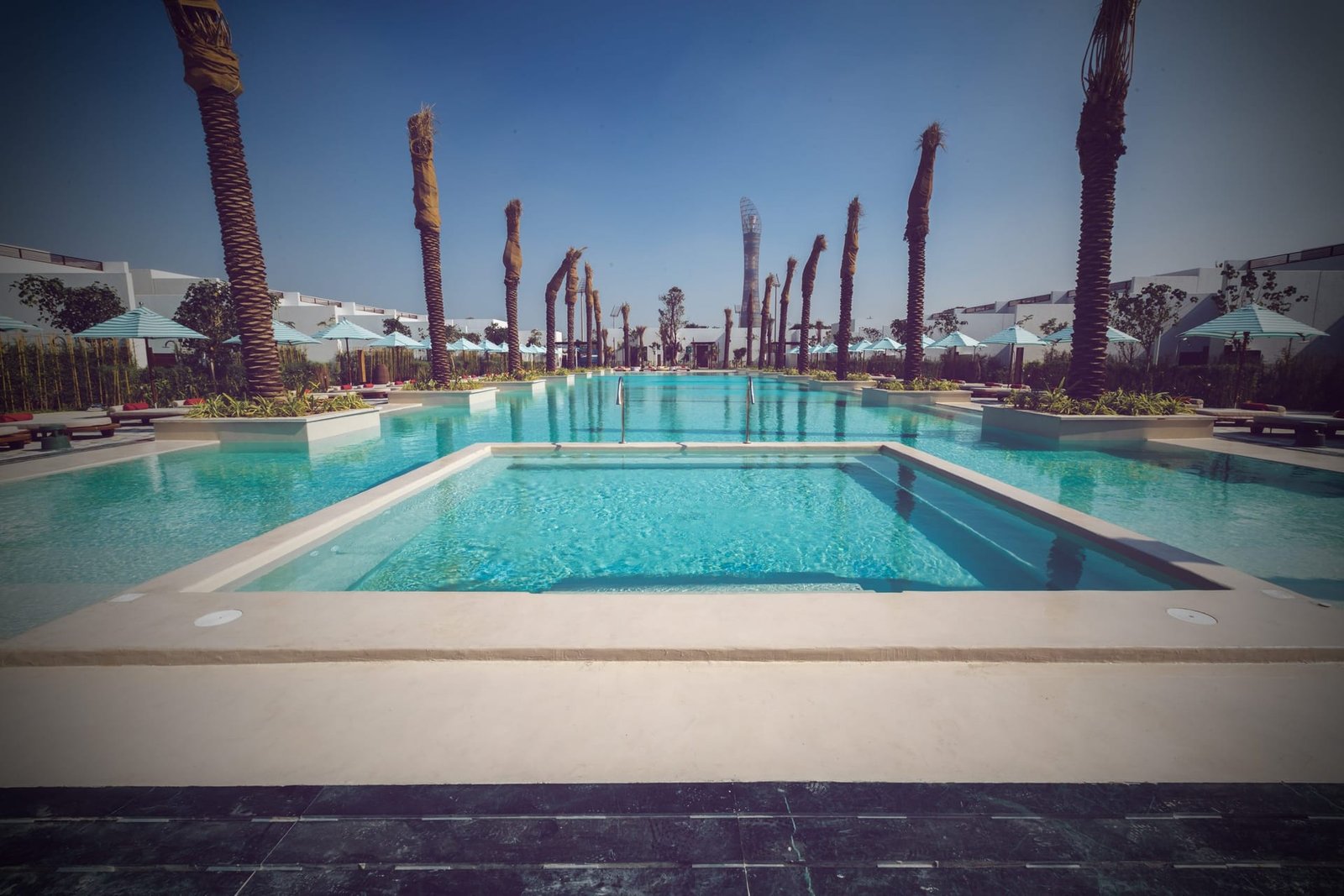
Only if it is the right microcement. Cemher's Microdur Plus is expressly not for pools or continuously immersed surfaces. Micropool is the immersion product, tested at 5 bar water pressure and through 28 days of immersion, and Microrock serves surrounds. We used the family at Maysan LXR and OQ Hotel in Doha.
The rule that sorts every pool enquiry
Cemher's microcement range answers the pool question with a product boundary, and it is worth quoting exactly. The limits on Microdur Plus — the product behind most of our interior floors and walls — state: not suitable for swimming pools or continuously immersed surfaces.
That is not a hedge against a marginal case. A pool never dries, carries treatment chemistry, and puts hydrostatic pressure on its finish continuously. Wet-area performance and immersion performance are different engineering claims, a distinction unpacked in is microcement waterproof.
The immersion claim belongs to a different member of the range. Micropool is the pool system, and every pool specification we produce starts from that sentence.
What makes Micropool different
Micropool is a two-component polymeric microcement whose data sheet carries the results a pool detail actually needs: water penetration under pressure at 5 bar for 3 days with no penetration, and 28 days of immersion without pressure. Its compressive strength is Class C80 — the highest in the range — with adhesion above 6 N/mm² and slip resistance at USRV 41, Class 2.
It comes in four grain sizes from Fine to Thick Base, covering pool walls, floors and steps, and its uses extend beyond the tank: pool surrounds, wet decks, and interior floors and walls where a matching finish is wanted. One product family can therefore carry the water, the deck and the room beyond it.
The honest notes travel with it. Reaction to fire is Class B rather than the A1 of Microdur Plus, it is sensitive to vinegar and other organic acids like the rest of the range, it does not go over electric underfloor heating, and application starts at 12°C with roughly 60 minutes of workability — a discipline for site programming, not a problem.
Pool interiors and pool surrounds are different jobs
The tank is the immersion case: permanently underwater, chemically treated, pressure-loaded. Only the immersion-rated product belongs there, over a sound, consolidated concrete shell. The structural tank and its engineering waterproofing remain the engineer's scope — the microcement is the finish on that assembly, not a substitute for it.
The surround is a different duty: sun, splash, bare feet, cleaning regimes and, in the Gulf, surface temperatures that make material choice a comfort question as well as a durability one. Micropool covers surrounds and wet decks; so does Microrock, the C80 high-traffic member of the range, which is what we used at OQ Hotel.
The wider subject of terraces, sun and exterior use is covered in microcement outdoors — a pool surround is the most demanding version of that brief.
Why designers want one material through the water line
The argument is continuity. A tiled pool is a grid; a microcement pool is a single mineral surface running from the room, across the deck, over the edge and under the water, with colour mixed through the material. Visually, the water sits in the architecture rather than in a lined vessel.
There is a maintenance argument beneath the aesthetic one. No grout means no joint lines for algae and dirt to colonise, and a continuous surface cleans as one plane. The finish still lives within a maintained pool: water chemistry kept in balance, pH-neutral cleaning at the deck, no acidic descalers.
Colour deserves early thought, because water reads through it — pale finishes give the water its light, mineral colour, deeper tones read darker and warmer underfoot. The palette logic is the same one set out in microcement colours, with samples viewed wet, not dry.
The Doha pool projects
At Maysan LXR in Doha, microcement runs through the main pool area as part of a scheme that also carries the courtyard and dining spaces — one palette from the interior out to the water.
At OQ Hotel, also in Doha, the pool surround is Microrock: the high-traffic, C80 member of the range, chosen for a deck that takes barefoot guests, furniture and daily cleaning in a hospitality setting.
Both projects make the same point in different ways: the specification is zoned. The product that serves the deck is chosen for traffic and slip; the product that serves the tank is chosen for immersion; and the room beyond can match both. Nothing in a pool scheme should be one product stretched past its data sheet.
What a pool specification needs from you
The tank first: a consolidated concrete shell, true in plane, dry and clean, with the structure's own waterproofing and movement detailing resolved. Micropool's substrate list is concrete and cementitious substrates — anything else is a conversation with the technical department before it is a specification.
Then the zones: where immersion ends and deck begins, where falls and drainage run, which surfaces need the most slip texture — steps and wet decks first. Grain size and sealer sheen are chosen per zone from the same colour, so the finish reads as one material doing several jobs.
Programme last: application from 12°C, roughly an hour of workability per mix, sealing once the finish has hardened, and the sealer fully cured before the tank fills. Filling a pool early is the one impatience the system cannot forgive.
Specifying a microcement pool in Saudi Arabia
Conmarble supplies and installs the full Cemher microcement range — Micropool for immersion, Microrock and Microdur Plus for the zones around it — with applicators on our own payroll and the Doha pool projects above as built references.
Send pool drawings, tank construction details and the extent of decks and surrounds through the enquire page, or message the Riyadh office on WhatsApp at +966 56 808 8273, and we will map the products to the zones honestly. Wellness, in Every Surface.