Cemher's Microdur Plus microcement is waterproof in mass — the manufacturer's own wording — and its sealed build-up suits bathrooms, showers and other wet areas. It is not an immersion product: pools and permanently submerged surfaces are excluded and belong to Micropool. Waterproofing detail beneath, sealer above, honest limits between.
What does 'waterproof in mass' mean?
Waterproof in mass is Cemher's own wording for Microdur Plus, and it is a precise claim rather than a slogan. The product is a three-component microcement — a cement-based powder mixed with two resins — so the water resistance runs through the body of the material instead of sitting on it as a film.
The data sheet backs the phrase with a test: water penetration under pressure at 5 bar for 3 days, with no penetration under direct pressure and no humidity on the indirect face, to UNE EN 14891 and UNI EN 12390-8. That is measured performance, not marketing.
There is a practical consequence on site. Because the waterproofing is in the mass, the system needs no separate pore filler before the sealer goes on. Coatings that rely entirely on their topcoat for water resistance are a different and weaker proposition.
If the material itself is new to you, start with what microcement is and come back to the water question afterwards.
So why does it still need a sealer?
Because the sealer does a different job. The mass keeps water out of the body of the finish; the sealer keeps daily life off its face — soap, skin oils, cleaning products, the general traffic of a working bathroom.
The specified sequence is Hidroprimer followed by Aquamax or Maxipur, applied 24 to 48 hours after the finish hardens and only once the surface is below 5% moisture. Skipping or rushing that step is a workmanship failure, not a shortcoming of the material.
The full build-up is short and disciplined: preparation and primer where the substrate needs it, two base coats with fibreglass mesh embedded in the first, finish coats, then the sealer. Every layer and figure is on the Microdur Plus data page, with the total thickness running 0.3 to 5.5 mm — covered in how thick microcement is.
Wet-area suitability is not immersion
The uses listed on the data sheet include bathrooms, kitchens and terraces — spaces that get wet and then dry again. A shower wall sheds its water within minutes. That cycle is what the sealed system is designed for, and it handles it well.
Immersion is a different regime. The Microdur Plus limits state it plainly: not suitable for swimming pools or continuously immersed surfaces. A pool never dries, the water carries treatment chemistry, and hydrostatic pressure works on the finish day and night.
Cemher answers that regime with a different product. Micropool is the immersion-rated microcement, carrying the same 5 bar pressure result plus a 28-day immersion test. We cover it separately in microcement for pools.
The distinction sounds pedantic until a finish fails. Wet-area suitability and immersion suitability are separate claims, and asking one product to carry both is how most of the bad microcement stories online begin.
What sits underneath in a shower
Microcement is a finish, not a tanking layer. In a shower or wet room, the project's waterproofing is the membrane beneath the finish, with falls formed in the screed and junctions detailed and sealed before any microcement arrives.
The result is a sensible redundancy. The membrane protects the building; the finish, waterproof in mass and sealed at the face, protects itself and stays cleanable. Each layer does the job it was designed for.
The full wet-room build-up, floor falls and hard-water care are covered in microcement bathrooms. If the shower already has tiles, microcement over tiles explains when the existing surface can stay.
Where lime and tadelakt answer instead
Microcement is not the only sealed mineral finish that lives happily in a wet room. Tadelakt is the hammam surface — lime polished to a closed, softly lustrous face — and Cemher's Microtadelakt carries the same 5 bar water-penetration record as Microdur Plus.
The choice is largely aesthetic. Microcement reads cooler and more architectural; tadelakt reads warmer and more hand-made. We set out the lime side in is tadelakt waterproof and what tadelakt is.
For a direct comparison across the families, see polished plaster vs tadelakt vs microcement — and microcement vs limewash for the painted lime cousin, which is not a wet-area finish at all.
Wet areas in the Gulf: what experience adds
Gulf water is hard, and hard water leaves mineral marks on any dark, smooth surface. Routine care is pH-neutral cleaning and a wipe-down of glass and dark floors after use. Vinegar and limescale removers are off the list: the data sheet states a sensitivity to organic acids, a point we treat just as plainly in microcement kitchens.
The application window matters here too. Microdur Plus is applied between 10 and 30°C, which in a Saudi summer means conditioned, enclosed spaces rather than site conditions left to chance.
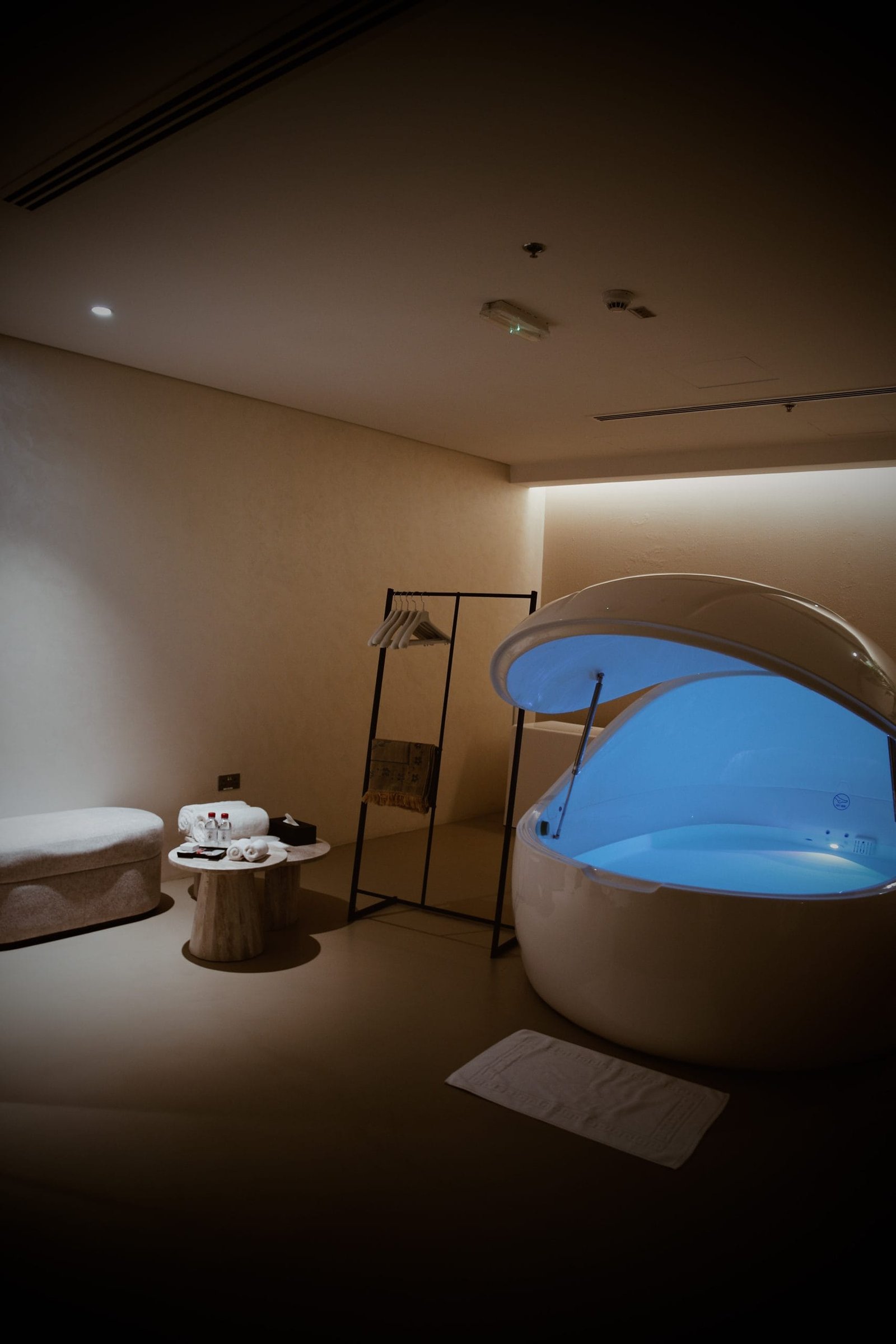
At Katara Hills LXR in Doha we installed Microdur Plus through the shower rooms and the flotation room — wet areas in daily hotel use, which is as honest a test as the material gets.
Specifying waterproof microcement in Saudi Arabia
Conmarble supplies and installs the Cemher microcement systems, with the applicators on our own payroll rather than subcontracted. The useful first step on any wet-area project is a sample panel and a short conversation about which product carries which zone.
Send drawings, wet-area extents and substrate details through the enquire page, or message the Riyadh office on WhatsApp at +966 56 808 8273. Wellness, in Every Surface.