Yes, with one caveat stated plainly. Cemher's TDS lists kitchen worktops and counters among Microdur Plus uses, and the sealed surface resists water, oil, coffee and soft drinks. It is sensitive to vinegar and other organic acids, so spills need wiping rather than leaving. For hard-working sink zones, stone or tile may still win.
What the data sheet actually allows
The specification question is settled by the manufacturer, not by enthusiasm. Cemher's TDS for Microdur Plus lists kitchens among its uses, and — separately and explicitly — the coating of furniture, shelves, kitchen worktops and counters. Worktops are not an improvisation; they are on the sheet.
The same sheet gives the performance behind the listing: surface hardness above 200 N/mm², compressive strength Class C50, adhesion above 6 N/mm², and abrasion resistance at the highest BCA class. Applied at 0.3 to 5.5 mm, it wraps a worktop, its edge and its upstand as one continuous surface.
For the material's fundamentals — what it is made of and how the system builds up — start with what microcement is and microcement thickness.
The vinegar sentence, stated plainly
The limits section of the data sheet says it in five words: sensitive to vinegar and organic acids. In a kitchen that means lemon juice, vinegar dressings, tomato and wine — the everyday acids of cooking — can etch or dull the sealed surface if they sit rather than being wiped.
The same tested chemical-resistance list is generous in the other direction: high resistance to ammonia, water, oil, soft drinks and coffee. The realistic picture is a surface that shrugs off most of what a kitchen throws at it, and asks for prompt wiping of the acidic remainder.
We state this because the durable specifications are the honest ones. A client told about the vinegar sensitivity on day one wipes the worktop and stays happy; a client who discovers it from an etch mark does not. The same honesty governs our wet-area advice in is microcement waterproof.
Heat, knives and the sealer
The mineral body of the finish is cementitious and fired by nothing a kitchen produces — the system carries reaction-to-fire Class A1. The working face, though, is the sealer, a polyurethane or acrylic layer, and it is the sealer that sets the practical rules.
Hot pans go on trivets, exactly as they do on timber, laminate or a sealed natural stone. Knives meet chopping boards, not the worktop: the surface records SH 200 hardness, but a blade scratches a sealer long before it troubles the cement beneath.
Scratches and etch marks in the sealer have a proportionate remedy — the affected zone can be re-sealed without removing the finish. That is a lighter intervention than re-polishing stone, and the repair logic is the same one set out in does microcement crack: work to natural breaks, expect maintenance at the face rather than failure in the body.
Floors, walls and splashbacks: the easy wins
The least contentious kitchen surfaces are the biggest ones. A microcement floor runs from the living space through the kitchen without a threshold, takes furniture with casters, sits over both hot-water and electric underfloor heating, and cleans without grout lines — the case made in full in microcement floors.
Walls and splashback zones take the same finish at millimetre thickness, over plaster, render or sound existing tile, so a renovation can wrap the room without demolition — see microcement walls and microcement over tiles.
This is where the seamless argument is strongest: one material across floor, wall and island face gives the kitchen the continuous, joint-free reading that tiles cannot, with colour mixed through the material rather than printed on it.
When tile or stone is the better answer
A worktop used for heavy daily cooking — citrus, vinegar, hot pans landing without ceremony — is better served by granite or a dense quartz, and we will say so at specification stage. Microcement worktops suit kitchens that are cooked in carefully and looked at often: display kitchens, pantries, islands that are more furniture than workbench.
Directly behind a professional-grade hob, tile remains a rational choice for the splash zone; it tolerates aggressive degreasers that a sealed microcement face should not meet. The comparison across materials is drawn fully in microcement vs epoxy vs tiles.
There is also a lime-side alternative within our own range: Cemher's Microtadelakt lists furniture and kitchen countertops among its uses and brings a warmer, more hand-made character — compared in polished plaster vs tadelakt vs microcement. Recommending the right material for the zone, including someone else's, is what keeps a specification credible.
Care in a Saudi kitchen
Daily care is undramatic: pH-neutral cleaner, soft cloth, no abrasive pads. The acids to keep off the surface are the organic ones already discussed — and the hard-water descalers sold for taps and sinks belong to the same forbidden list, a point that matters wherever Gulf tap water leaves its mineral marks.
Spills are a habit rather than an emergency. Oil, coffee and soft drinks are on the tested-resistance list; lemon and vinegar are not, so the discipline is simply to wipe as you cook, which most kitchens do anyway.
Longer term, the worktop face is inspected where the work happens — around the sink and the prep zone — and re-sealed when wear shows. The finish beneath does not need replacing; the sealer is the sacrificial layer, by design.
Specifying a microcement kitchen in Saudi Arabia
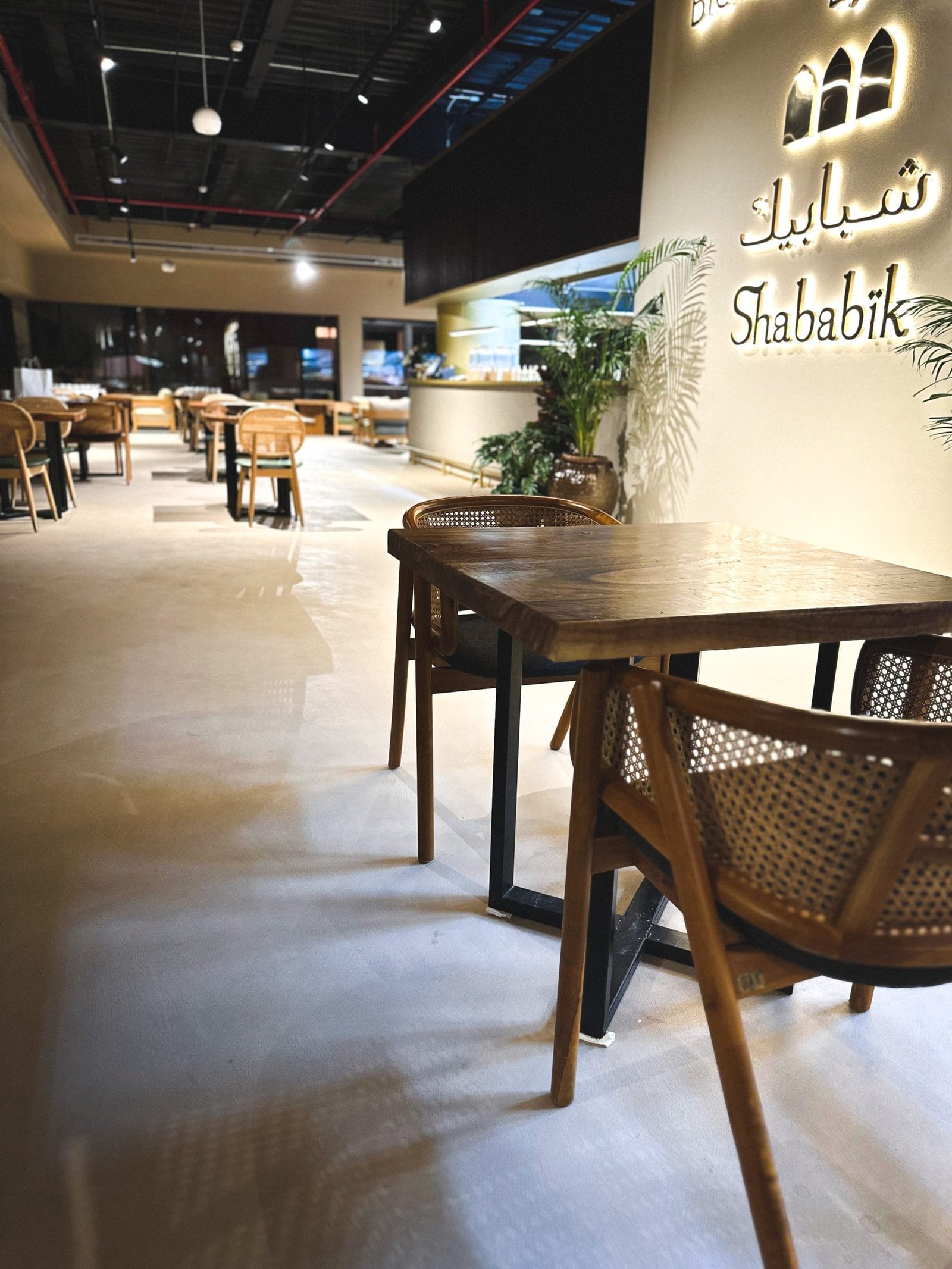
Conmarble supplies and installs the Cemher microcement systems with applicators on our own payroll. In food-service settings the material has already proved itself in our work at the Islamic Arts Biennale restaurant in Jeddah and the dining spaces of Maysan LXR in Doha.
The right first step is a sample panel and a plain conversation about how the kitchen will actually be used — display or workhorse, island or splash zone. Send drawings and the finishes schedule through the enquire page, or message the Riyadh office on WhatsApp at +966 56 808 8273. Wellness, in Every Surface.
If the kitchen opens onto wet areas, read this alongside microcement bathrooms — the two rooms are usually specified as one continuous decision.