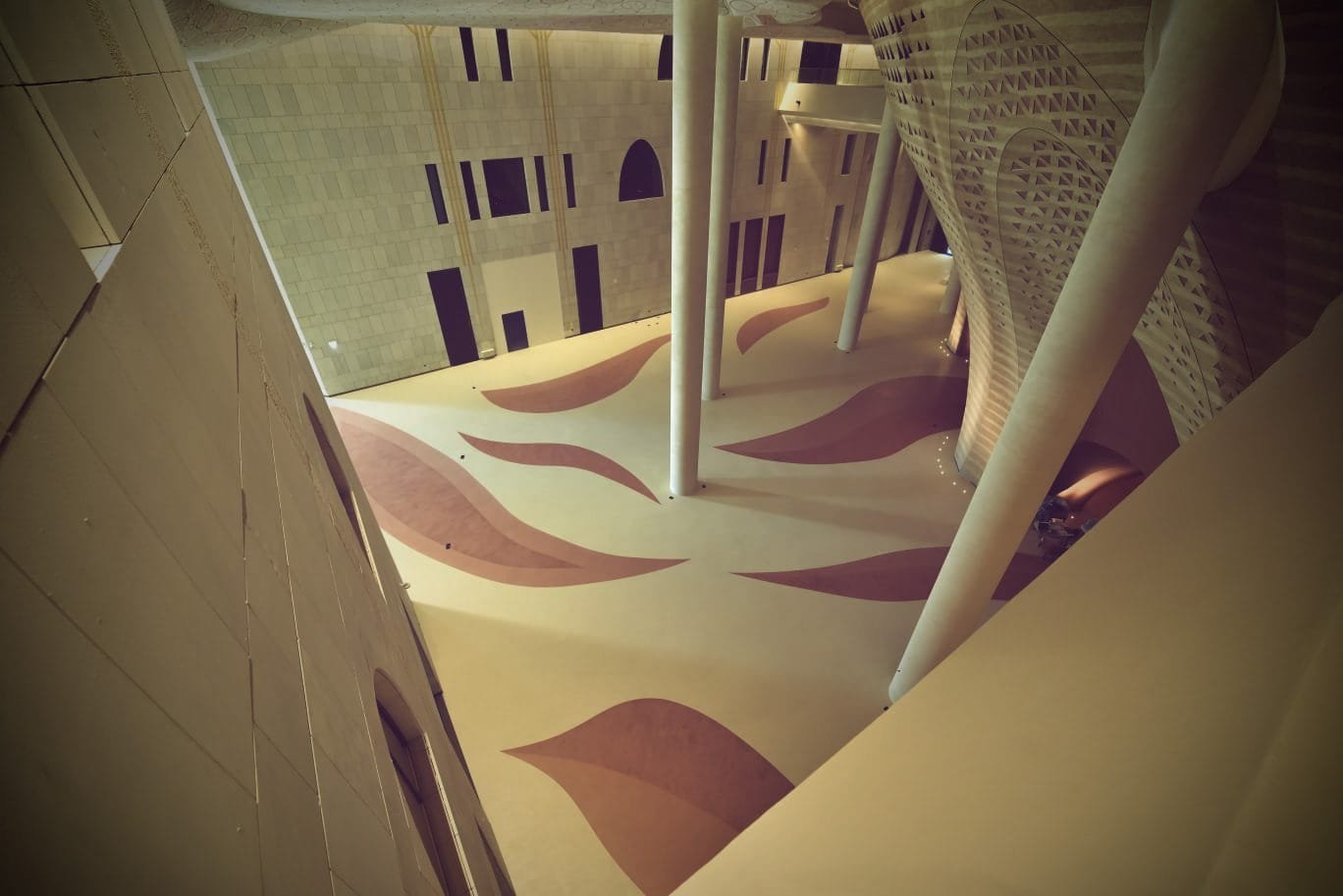
Microcement floors are hand-applied cementitious surfaces at roughly 2 to 3 millimetres, laid seamlessly over concrete, screed or existing tiles. Specified correctly — sound substrate, mesh-reinforced base coats and the right sealer — they take hard daily traffic, and Cemher's Microdur Plus runs over both hot-water and electric underfloor heating.
What is a microcement floor?
A microcement floor is a system, not a single layer: substrate preparation, base coats with an alkali-resistant fibreglass mesh embedded in the first, finish coats in the selected grain and colour, and a sealer. The whole build lands at around 2 to 3 millimetres, covered in detail in how thick is microcement.
The result is a continuous surface without grout lines, thresholds or joints in the field of the floor, which is most of the reason architects specify it. Colour is pigmented through the coat, and texture comes from the grain and the trowel.
It is a cementitious coating rather than a natural finish, and we say so plainly. What it offers over the natural materials is exactly this: a floor. Clay and lime do not do floors; microcement was made for them. The fundamentals are in what is microcement.
Which Cemher systems belong on floors?
Microdur Plus is the default: a three-component microcement for interior and exterior floors on cementitious substrates, compressive class C50, waterproof in mass in Cemher's wording, and rated for furniture with casters. For homes, hotels, offices and retail it is the system we price first.
Microrock is the heavy-duty answer: a two-component polymeric microcement at compressive class C80, specified for garages, warehouses, galleries, stores, waiting rooms and corridors. Its four grain sizes all work on floors, and its base coat goes down at 2 to 3 millimetres in two layers.
Around water the range splits by exposure. Pool surrounds and wet decks take Micropool or Microrock depending on the detail — at OQ Hotel in Doha the pool surround is Microrock — while immersed surfaces are Micropool territory only, covered in microcement pools.
The substrate decides the floor
Cemher asks for a consolidated cementitious substrate in good condition, and for Microrock puts numbers on it: minimum 25 N/mm² compressive strength and 1.5 N/mm² pull-off. A floor coating a few millimetres thick has no structure of its own; everything it does, it does on the back of the slab beneath.
Preparation is where floors are won. The substrate must be clean, dry and free of grease; weak surfaces are consolidated, and where rising damp or residual moisture exists, the data sheet route is a barrier such as Vapoepox before any microcement goes down. Existing movement joints are respected and carried through, never coated over.
Old ceramic tile is a listed substrate for Microdur Plus, which makes tiled floors a legitimate starting point — see microcement over tiles. Flatness, though, is set by the background: microcement is a finish, not a levelling layer, and an out-of-plane floor stays out of plane.
Most microcement floor failures anyone can point to are substrate failures. The honest account of what cracks and why is in does microcement crack.
Microcement and underfloor heating
The systems differ, and the difference matters at specification stage. Microdur Plus is approved over underfloor heating in both hot-water and electric forms, which is unusual and useful: the same finish can run from a heated bathroom floor into an unheated corridor without changing system.
Microrock is the opposite case: its data sheet excludes it from underfloor heating altogether. If the project wants the C80 system in a heated zone, the specification has to change, not the heating.
The usual discipline for coated heated screeds applies regardless: the screed fully commissioned and cycled before coating, then heated gently rather than shocked. The coating follows the screed, so the screed's behaviour is the floor's behaviour.
Traffic, wear and cleaning
The durability numbers are on the data sheets rather than in the brochure copy. Microdur Plus tests at over 200 N/mm² surface hardness, abrasion class AR 0.5 and impact resistance above 25 Nm; Microrock raises the compressive class to C80 for genuinely hard-worked floors. These are EN-standard results, not marketing figures.
The sealer is what daily life actually touches, and it is chosen to suit: Maxipur, the two-component polyurethane with high chemical resistance in matt, satin or gloss, or the water-based Aquamax. Resealing on a maintenance cycle is how a hard-worked floor stays presentable for years.
One honest limit: the cementitious systems are sensitive to vinegar and other organic acids. On a floor this mostly means choosing cleaning products with care — no acid descalers, spills wiped rather than left. The same caveat governs worktops, covered in microcement kitchens.
Microcement floors in Riyadh and across Saudi Arabia
The demand is real and local. Riyadh's current design direction — minimal planes, natural texture, continuous lines — is a microcement brief almost by definition, and the material's tolerance of hard traffic suits villas, boutique hotels and retail equally. Application sits within a 10 to 30 degree window, which on Saudi sites means conditioned spaces or sensible scheduling, not summer slabs at noon.
The reference we point specifiers to is King Fahad Cultural Centre in Riyadh, where microcement runs across the atrium floors, the foyer steps and staircases, and the grand hall — a public building where the floor takes event traffic, not domestic slippers.
For exterior terraces and the questions heat and sun raise, see microcement outdoors. For the comparison most clients ask for, see microcement vs epoxy vs tiles.
Specifying a microcement floor in Saudi Arabia
Conmarble supplies and installs the Cemher floor systems across Saudi Arabia with applicators on our own payroll, which is what makes a consistent surface across a large floor plate achievable. The system data sheets and clauses sit on microcement.
The useful first steps are a substrate survey and a sample panel in the real light of the real space, agreed before the finishes schedule is locked. Both cost little and prevent most of what goes wrong.
Send drawings, floor build-ups and the finishes schedule through the enquire page, or message the Riyadh office on WhatsApp at +966 56 808 8273. Wellness, in Every Surface.