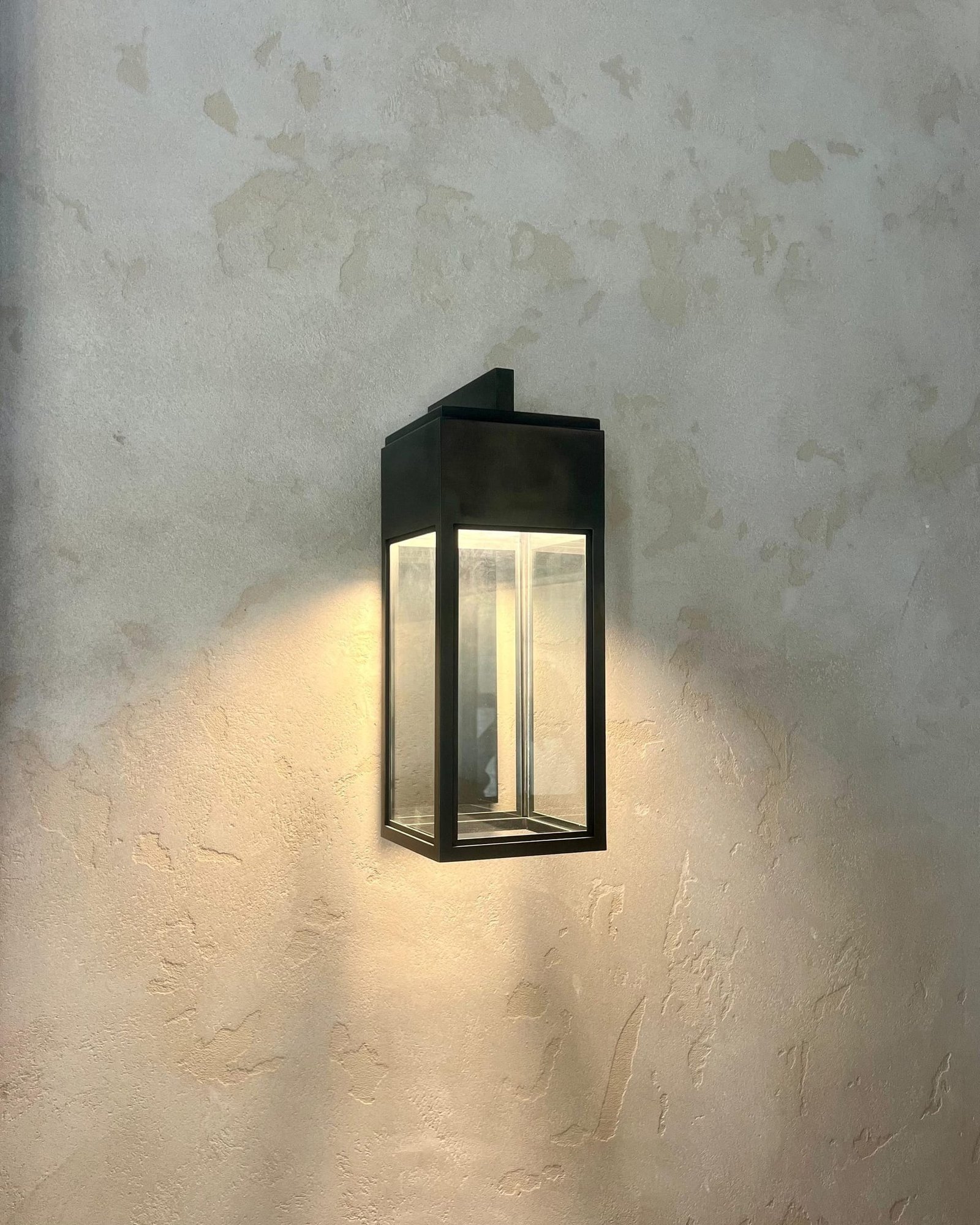
Microcement carries walls and ceilings as one seamless plane, hand-trowelled at a few millimetres over concrete, cementitious render or old tiles. Unlike clay plaster it can serve direct-water zones such as showers when the wet-area system is specified, and texture and sheen come from grain size and sealer.
The seamless plane
The case for microcement walls is continuity. Wall, reveal, niche, ceiling and, if wanted, the floor beneath can all carry the same material with no grout line, movement break or change of finish. Corners are formed, not trimmed.
That continuity is why the material suits the current direction of Saudi interiors: large uninterrupted planes, low visual noise, texture doing the work that mouldings used to do. A microcement wall reads as a single made surface rather than an assembly of parts.
Cemher's Microdur Plus is specified for exactly this scope — continuous coatings for floors, walls and ceilings, interior and exterior — so wall work is not an off-label use of a floor product. The fundamentals of the material are in what is microcement.
Walls where clay cannot go
Clay plaster is a natural finish we install with conviction, and it has a firm boundary: interior walls and ceilings away from direct water. The inside of a shower enclosure or the splash zone around a basin is not clay territory, as we set out in what is clay plaster.
Microcement crosses that boundary. Microdur Plus is waterproof in mass in Cemher's wording and is specified for bathrooms; sealed correctly, it lines shower walls and wet rooms as a continuous surface with no grout to discolour. The full case, with its honest conditions, is in microcement bathrooms and is microcement waterproof.
The trade-off is equally honest: microcement is a sealed cementitious coating, not a breathing natural material. Where clay buffers humidity and stays reworkable, microcement offers hardness and water tolerance. A well-planned scheme often uses both — clay through the dry rooms, microcement through the wet ones — compared directly in microcement vs limewash.
Texture and sheen: the range on a wall
Texture starts with grain size. The Cemher systems come in graded versions — Microrock and Micropool in Fine, Medium, Base and Thick Base, Microdur Plus in Regular and Base — and the finer the grain, the quieter the surface. Fine grains on walls read almost as polished stone; coarser grains keep a visible mineral tooth.
The trowel adds the second layer: hand application leaves soft clouding and movement in the surface that is characteristic of the material, not a defect. Two applicators can pull noticeably different character from the same bucket, which is one reason our applicators are on our own payroll.
Sheen is decided last, by the sealer — matt, satin or gloss in the Maxipur polyurethane range. Gloss deepens colour and movement; matt softens both. Colour itself is pigmented through the coat, covered fully in microcement colours and textures.
Ceilings, stairs and the vertical scope
At 2 to 3 millimetres the material adds no meaningful weight, so ceilings and soffits are a normal part of the scope rather than a special case. The same coat that turns a wall corner runs onto the ceiling plane without a break — the detail that makes small bathrooms read larger than they are.
Fire behaviour matters on ceilings, and Microdur Plus carries Class A1 reaction to fire, the top classification. Its A+ rating for emissions into indoor air belongs in the same sentence for interior work.
Stairs are where wall and floor scope meet, and microcement handles treads, risers and strings as one surface. The floor side of the material — traffic, hardness, underfloor heating — is covered in microcement floors.
What the wall underneath must provide
Cemher's listed substrates for Microdur Plus are concrete and cementitious substrates in consolidated, good condition, and old ceramic tile — clean, free of grease, with no bonding bridge required. Tiled bathroom walls are therefore a genuine starting point, covered in microcement over tiles.
Anything outside that list — weak, crumbling or damp backgrounds in particular — is referred to the technical route rather than improvised: consolidators and damp barriers exist in the system for exactly these cases. A survey decides it, not optimism.
Flatness is set by the background, because a few millimetres of coating cannot correct a wall that is out of plane. And as on floors, movement is the honest enemy: the coating follows its substrate, so background cracks telegraph through. See does microcement crack.
A reference: the Islamic Arts Biennale, Jeddah
At the Islamic Arts Biennale in Jeddah, Microdur Plus carries a restaurant interior — walls and floor as one continuous, quiet surface under public traffic in a cultural landmark.
A restaurant is a useful proof for wall work: the surface takes chair-backs, cleaning regimes and the occasional impact, and it has to look composed doing it. The material's documented hardness is what lets a seamless finish survive that brief.
Alongside it sit the hospitality interiors at Katara Hills LXR and Maysan LXR in Doha, where the same system runs through lounges, dining rooms and wet areas. The project record is on projects.
Specifying microcement walls in Saudi Arabia
Conmarble supplies and installs the Cemher systems across Saudi Arabia, walls and ceilings included, with applicators on our own payroll. Data sheets and specification clauses sit on microcement.
For wall work above all, insist on a sample panel in the real light of the real room: sheen and clouding read differently on a vertical plane than on a board in a showroom, and the panel settles expectations before the schedule is locked.
Send elevations, substrate details and the finishes schedule through the enquire page, or message the Riyadh office on WhatsApp at +966 56 808 8273. Wellness, in Every Surface.