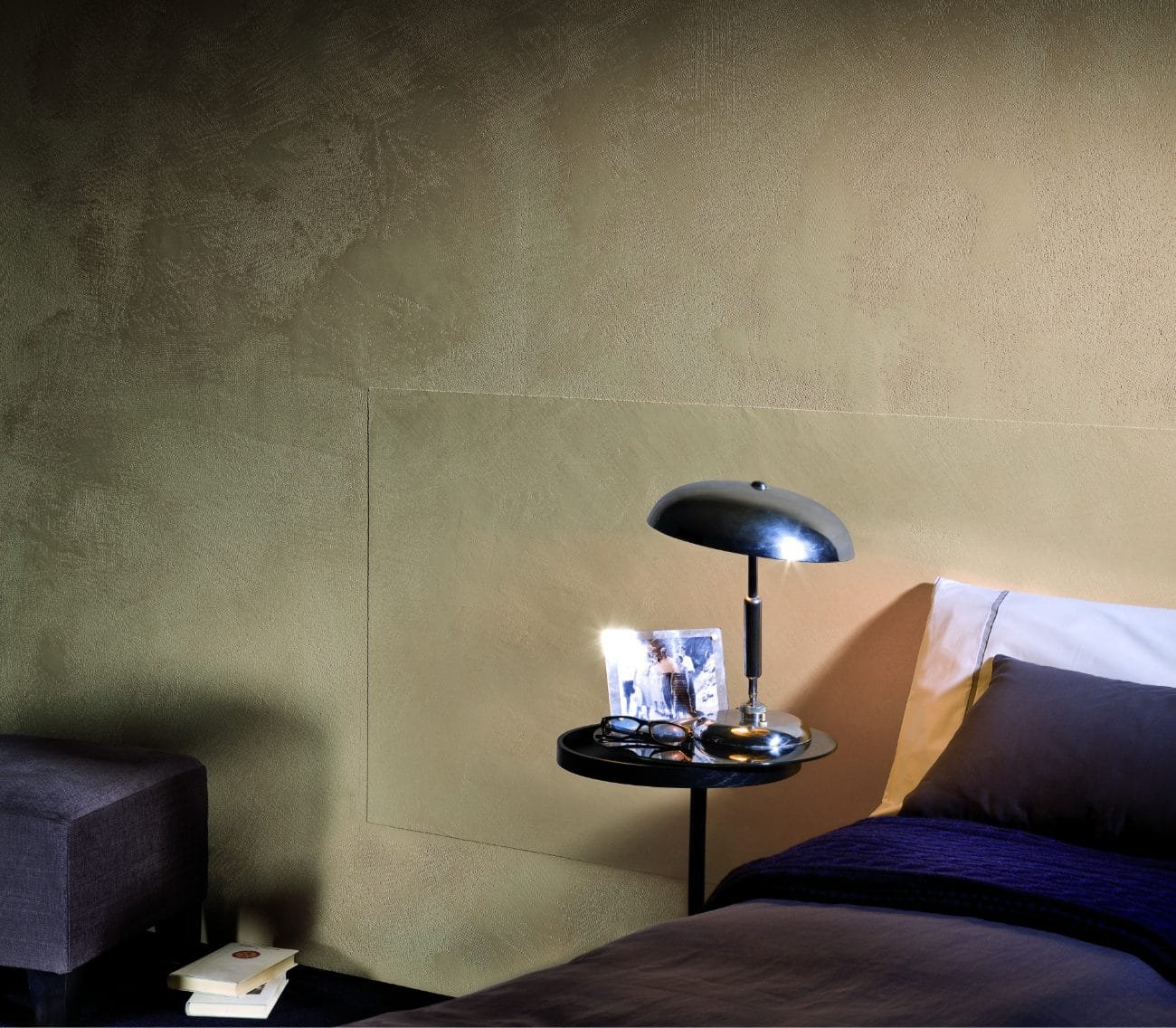
Clay wash is applied to sound, dry, prepared interior walls and ceilings in two brushed coats, using a natural bristle block brush. Preparation decides the result: sealed, glossy, damp or dusty backgrounds must be corrected first. It dries by evaporation, can be touched up locally, and is recoated rather than stripped.
Start with the substrate, because the substrate decides everything
The Cemher Claywash data sheet gives the substrate requirement in one phrase: prepared internal wall and ceiling substrates. The word doing the work is prepared. Sound, dry, clean, free of dust and grease, and with enough absorbency for a water-mixed mineral paint to grip.
Plasterboard, gypsum plaster, cement render and existing mineral finishes can all be brought to that condition. What cannot take clay wash as found is anything sealed: gloss paint, vinyl emulsions in poor condition, waxed or oiled surfaces, or walls treated with a water repellent.
This is the same discipline as our plaster work, described in clay plaster substrates. The survey is done by touch and test patch, not by eye — a wall's appearance says very little about what is on it.
Priming: regulating absorption, not adding stick
Where a primer is used under a clay paint, its job is mostly to even out absorption. A wall that drinks unevenly — patched plaster next to old paint next to filler — will show every patch through a thin mineral coat, because each zone pulls water from the paint at a different rate.
The primer must be compatible with a breathable mineral finish. A film-forming acrylic sealer defeats the point of the material by closing the surface it needs to grip.
Which preparation a given wall needs is decided at the survey, and on anything larger than a room we prove it with a sample panel on the actual substrate before the schedule is locked. That panel settles colour and preparation in one exercise.
Mixing and coats
Cemher Claywash is a one-component product supplied as a dry powder in 2 kg packs, mixed on site with water to a brushable paint. There is no second component and no pot-life drama; the discipline is consistent mixing, so every batch carries the same pigment load.
The specification is two coats. The first coat reads patchy and translucent as it dries — that is normal, and judging colour from a first coat is the most common site misunderstanding with mineral paints.
Coverage is 3.5 litres of mixed paint to 20 square metres in two coats, which makes quantity take-offs straightforward from the wall schedule.
The brush, and why not a roller
The specified tool is a natural bristle block brush, and the choice is not tradition for its own sake. Brushed clay wash carries a faint directional movement — the record of the stroke — and that movement is the finish. It is what separates a clay wall from a flat emulsion in the same colour.
A roller produces uniformity, which sounds like a virtue until you see it: rolled mineral paint loses the tonal drift and reads as ordinary matt paint at higher cost. If uniformity is genuinely what the scheme wants, an honest specifier chooses a different product rather than fighting this one.
Technique is unhurried: full strokes, wet edges kept moving, and no over-brushing of areas that have started to dry. Overworked patches show as burnished streaks in raking light.
Drying and site conditions
Clay wash dries by evaporation — there is no chemical cure, which is why the material remains touch-up friendly for life. The first coat must be fully dry before the second goes on.
The data sheet sets a minimum application temperature of +10 °C, which a conditioned Saudi interior meets trivially. The practical site conditions are the usual ones for water-based mineral work: reasonable ventilation, no direct blast from an AC outlet drying one wall faster than its neighbour, and dust-generating trades finished before the brushes come out.
Very fast drying is the regional caution. Air conditioning running hard in an unoccupied fit-out can pull water out of a coat quickly enough to leave lap marks, so sequencing the wash near the end of the programme, in stable conditions, is worth the coordination.
Repair and recoat
Because the finish dries rather than cures, local repair is genuinely local. A scuffed or stained area is touched in with the same mixed material and feathered out; there is no film edge to telegraph the repair the way a patch shows in sheened emulsion.
Recoating is a single further brushed coat over a clean, sound, dusted surface. Nothing is stripped. This is the quiet economic argument for mineral paints: the maintenance cycle is thin and additive rather than remove-and-replace.
The one discipline is record-keeping — note the product, colour reference and batch on the O&M schedule, so the touch-up five years later is mixed to the same recipe.
What failure looks like, and why it is almost never the material
Clay wash fails in predictable ways: it powders off a dusty background, peels off a sealed one, shows every patch over uneven absorption, and maps every hairline crack in a moving substrate. Each of those is the wall reporting its own condition through a thin, honest coating.
The pattern is the same across our materials — most failures anyone can point to in clay plaster or clay paint are substrate failures. A mineral finish has no film thickness to bridge problems, so it tells the truth about whatever it was applied to.
The remedy is unglamorous: survey properly, prepare properly, panel properly. Done in that order, the application itself is two calm days of brushwork.
Specifying clay wash application in Saudi Arabia
Conmarble supplies Cemher Claywash and applies it with our own people, which means the substrate survey, the preparation and the brushwork sit under one responsibility rather than three. What the material is and where it belongs is covered in what is clay wash.
For project walls we begin with a brushed sample panel on the real substrate, agreed before the finishes schedule is frozen.
Send drawings, substrate details and the finishes schedule through the enquire page, or message the Riyadh office on WhatsApp at +966 56 808 8273. Wellness, in Every Surface.